Showing posts with label weather. Show all posts

Monday, October 30, 2017

Art School Week 8: The Time Is Flying By

Another "week in review" post. I wonder if the format of these is getting stale. Still, I don't think I have enough to break things up into per-class posts this time around. I'll do my best to keep it interesting but there are no promises.

First off, ceramics:

We bisque fired our slab built projects, and though I have seen mine, but I didn't get photos of it yet. I am pleased with the slip application, at least. The white is opaque - not showing the terracotta through it - and the black stripe looks good too. The wonky angles still bug me, but I am certain if I was making more things like this I would get better at it. Two clay projects do not an expert make.

We also started throwing on the wheel. We're using 1.5 to 2 pounds of a white clay. I think I tried it 4 or 5 times last Tuesday and had reasonable success for someone who has never done it. Getting the clay centred is a pain. And there are many other ways to mess up a simple cylinder. Today (Sunday) I went in and did some more practising. I tried several times and had a few disasters, two that didn't fail but were not great, and one that was barely "meh". Or that's how I recall it anyway. Here's a picture of the one the best one, cut open so I can examine wall thickness:


Not too bad, really. Still a long way to go, but I am willing to put in the effort. Also note that we are not yet saving anything. It's throw a cylinder, then recycle the clay and try again. There will be more practising on Tuesday, I believe, and we're going to glaze our slab projects so they are ready to fire at some point soon.

Then came art history on Wednesday, in which we took the mid term exam. I don't have results from that yet, nor a grade on my paper. The instructor has a huge stack of stuff to grade, so perhaps I will get it back this week.

Painting - also on Wednesday - saw us doing life painting again. I think I did a bit better this time around. Some of the stuff I produced was awful, but some was ok(ish). Here's the best of the day:


That's not terrible, even if her nose is way too big. Next week we start in on some long term painting project that takes us to the end of the semester. No clue what it involves yet. Also, for those who are really interested, a question I posed to Giselle Lawson turned into a very interesting discussion over on Facebook about painting and how to evaluate the quality of such. Quite enlightening. If you know Giselle, check out her posts there to find it.

Also on the painting class, I give you pictures of the Buffalo Lounge, which is a central open area in the middle of all the fine and performing arts classrooms. This week the painting instructor has a huge selection of paintings up from his various classes. I am astounded to admit that there are four from me in there. Two definitely should not be there, one of which I have never published a picture of because it is so bad. My intent was to gesso over it but the instructor grabbed it from my storage space without telling me. Maybe it's intended as an example to others: don't do this. I dunno. But it's on the wall, and I am not pointing it out. Anyway, here are some shots of the exhibit overall:


At least one of those is a bit blurry. Sorry. Didn't note that when I took the picture yesterday.

Thursday's design class had us all working on our "bug based" pavilion models. After all of class plus a bit of time after, and four more hours today, I'm done. Here's what the table I was working at today looked like:


Quite a mess, and what can't be pictured is my phone playing a constant stream of songs by the Dresden Dolls to keep me moving. Here's a picture of the stuff I've made for the assignment before it gets turned in:


The presentation for this will be fun, actually. I might have mentioned before that I was planning to do something relating to fireflies for this assignment, but in the end I gave up on that idea. Everything I was thinking was too complicated or didn't work at all. The new concept is wings. The idea is that the pavilion is a set of large sculptures (four shown above) that detail the differences between the many kinds of insect wings, giving the garden a chance to explain the evolution of insect wings, and show their differences in great detail. I also added an entrance marker (the thing in the front, centre) and some people for scale. (Yes, these are really big, as proposed.) Of course this is just a project, and the local gardens won't build anything for anyone, but it's kind of fun. Next we we get to present these things to the class as if we're presenting to the garden staff. Should be entertaining.

And finally there was drawing class on Friday, were we turned in an interior drawing in 1 point perspective. Here's mine:


I didn't get a perfect score on it because my line quality sucks. We were told to finish it with a sharpie, and I did that. But sharpie and ruler is a lousy combination, so I used it freehand, and the resulting lines have some wiggle because I couldn't bear down on them without turning things into a huge blort of ink. Still, an OK grade, and life goes on. Next we we're doing in interior 2 point perspective and I have some pens now that will work with a ruler, so that should be better. I hope. The ocean map on the floor is the "something weird" we were supposed to add to the drawing. And yes, this is a bit of the interior of the house we are renting. It's not as big as that image would suggest, though. We were instructed to leave out the furniture if it didn't line up with the same vanishing point, and you can't see the mountain of boxes behind the viewpoint from which that image was drawn.

In addition to all of that, I took a big English test on Saturday, which kept me busy for several hours. It is part of proving to the Canadian Government that I am fluent in English. It was pretty funny, really, and a huge waste of time in a number of ways, but it had to get done.

Amusingly, while waiting to register to take the test, I found this:


By way of explanation, I took the test in Richmond, which has a huge Chinese population. There are all kinds of businesses in town that have no English on their signs at all, just Chinese characters. The test was given in a set of rooms that belongs to a tutoring/teaching business that caters to parents wanting to get their kids into elite colleges. It's in an odd mall in town, full of Chinese only businesses, including several tutoring schools. (I wonder if the trinket shop and the book shop I saw on the 6th floor are really legit, or instead are fronts for something else. I can't imagine a lot of customers take the elevator to that floor to buy Chinese trinkets. But I digress.)

Anyway, I took that photo while pacing around. I found it funny to see the obviously stock photo of the white student - too old to be a high school student, but maybe a late college student? - on an ad covered in Chinese. As you can see, the only non-English on there are 2 URLs and the string "VIP" in the middle of something in Chinese. I tried to translate it with my phone, but I didn't have the Chinese translation dictionary installed and didn't want to download it over the air. I did check out the QR code, though, and found it was a link to a Chinese chat app's entry in the Google Play store. Maybe if I had the app installed it would have taken me to something deeper, but I didn't, so that's what came up.

I admit to being amused by little things, but that ad did make me chuckle. And I need it they didn't start registering us until 30 minutes after the appointed time.

All of the above - class & test - was accomplished after being flat-on-my-back sick last Monday. Not fun, and I am still recovering from the cold. Mostly now all I have is a sporadically runny nose and occasional cough. Energy levels are creeping back up towards normal.

Finally, I've had requests for more dog photos, and there are those in California who might wonder what the weather is like up here vs. down there.  On the latter, it's pretty cool. I think we were down to 2° C this morning. It's sunny right now, but rains regularly - perhaps every three or four days. The locals all tell me that a time will come when it rains for a month, but so far I have my doubts. There was a prediction of mixed precipitation that would include snow for a couple of days from now, but that's dropped back to just rain, last I checked. So nothing like California weather, and it makes me very happy.

Oh, and it's Fall, so the trees are turning colours and dropping their leaves. Back at our old place in CA that happened in about August. OK, I exaggerate a bit, but the buckeyes did that, and the maple started then. The fruit trees waited a bit longer. Nothing else changed, though. The oaks & redwoods keep their leaves all year round, so Fall doesn't mean much, at least not visually.

As for dog pictures, I don't have anything new this month, but I'll try to get some next time around, assuming I remember. Being at school so much I don't take a lot of pictures of them. But maybe Anne will have some.

Saturday, October 21, 2017

Week 7 of art school

It's hard to believe that I've through seven weeks of the first semester already.

I am already starting to plan my classes for the spring semester. Registration starts pretty soon, and I need to be ready.

In any case, here is what happened last week:

In ceramics, I decided that my project was too plain, so I added a vertical stripe to each piece. This was done with black slip applied over white slip. I hope it looks good after firing, but who knows. This is the pieces all disassembled and continuing to dry in preparation for bisque firing next week:


Nothing is perfect in this work. Things are all slightly askew, in particular, and there is some surface roughness that I am less than entirely happy with. But overall I have hope they will turn out well once they are glazed. The plan remains to glaze them all with a turquoise glaze over the white (and now black) slip. There is also a chance I will instead use different colours on some of the sections, but I am not all that thrilled with the other colour choices available to us in this project. There are seven glazes we can choose from, but two react badly with black slip (making a mess in the kiln and possibly damaging nearby pieces in the process) and one is the same clear we used last time. That leaves just four new glazes that will work in my case. Oh, and we're not allowed to overlap the glazes either, to avoid drips & runs in the firing process.

Art history - AKA Visual Culture I - was another lecture that will be included in the mid-term, which is next week. That will be my first college test in over three decades. The instructor tells me not to worry about it - she says I will do just fine - but no one does these things calmly. I will be fine, I know, but it does add stress.

Painting class this week was another round of life painting, at which I continue to stink - and a very amusing homework assignment. First, though, the best painting from the in class life painting session:


I told you it was pretty bad. That's on paper, as the canvas painting was even worse.

The painting homework this week is to paint something from a song. Any song. It could be what the song makes you see or feel, or it could be a narrative of the song itself. I've got several relatively obscure things running around in my head as a result, and I am not at all sure which I will choose. Or I might get crazy and do more than one. Dunno. Results of that effort will appear here next week assuming they don't stink too.

Design studio gave us a new project: we're building a model of a pavilion for a garden here in Vancouver, based on something to do with insects: their movement, life cycle, etc. We are not, however, supposed to have the pavilion be a giant insect. I've been toying with fireflies, but I am not happy with the things I have come up with so far. As a result, this weekend has me pondering this assignment again. We get a couple of hours in class to work on it this coming week, but it's due at the end of class, so I need this resolved and worked out. Also, he gave us back our grades on the wire model/movement work, and I got another A. Seems like things are going well in that class for me.

Finally we had drawing class yesterday, and we turned in our assignment from last week. That was a triptych in which we setup a still life and did some interesting things we positive vs. negative space. We were working on manila paper with charcoal and chalk or white pastel (or Conté). Here's what I turned in:


And here's what the still life setup for it looked like:


There are some interesting distortions in in, but I am reasonably happy with the results. Apparently the instructor was as well. A perfect score and a request that she be allowed to keep it for a while (along with several others) to put up on display somewhere. The drawing homework for this week is an interior drawing of a house in one point perspective, with something wacky added to it. I have ideas, but I am more worried about other homework due sooner, so it will wait a while.

I'd say that ended the week, but as dinner was ending I was starting to feel a sore throat come on, and it only got worse over night. I appear to have a cold. Not fun.

I did go out and buy an A/V receiver to replace the dead one, so we can once again drive real speakers when watching TV. I haven't completely set it up yet, but we used it last night and it sounded pretty good. Just a cheap Yamaha in this case - last year's model, even - but it will do the job.

In other news, the weather in Vancouver has continued cool and rainy. We keep hearing fairly apocalyptic weather predictions on the CBC radio in the morning: huge storms that will produce 22-50 mm of rain. You do the math, but it's nothing compared to what we experienced in the Santa Cruz Mountains.

And speaking of those, there was a pretty large fire something like seven miles from our old home last week. Called the Bear Fire, it's in really rugged terrain, and in a very odd area where there are a lot of transients and a fair amount of illegal activity. I was in there a few times when I was a member of the VFD, and it's the place where I was famously told by a local that we should not leave the fire engines unattended overnight or they would be stripped clean. Very weird. Anyway, it's currently listed at 391 acres and 50%  contained. CalFire seems to be getting a handle on it. I have stopped worrying about it. I think they finally got a little rain down there as well, which is good.

That ends this week's update, I think. With luck this cold will pass quickly, I'll get painting & design done this weekend, and the art history test will go well. Time will tell.

Thursday, October 12, 2017

Vancouver Weather (Updated a day later)

It's wonderful. This was in the yard today, a couple of hours after I got home:


That's a pile of hail that collected off a spot in the roof where things come together.

It's cold enough that it had not all melted after quite a few hours. Mostly, though, it's just a bit rainy and cool. Quite nice, really. My kind of weather.

I know other places have it rough, but so far I am quite happy with Vancouver weather.

Update: about 12 hours later, here's what that pile of hail looked like:


Yes, it's a bit smaller, but it was still there. It survived overnight.

So, yeah... it's been pretty cool here.

Wednesday, August 2, 2017

First Impressions

We are settling into our rented house now, and waiting for the moving truck to arrive next week. The dogs are getting lots of walks, and we are doing lots of yard work to catch up with a suburban lot that wasn't maintained for months.

The house has more than a few quirks, but it is pretty liveable. The biggest problem is that our oldest dog hates the fake wood floors. They are slick and noisy when her toenails encounter it. And given it sounds like it is raining whenever she walks around downstairs, there is a lot of toenail / floor interaction going on. Even worse is that she has her paws spread as wide as they will go, and is nervous about her footing, which only makes things worse. Thankfully we have a number of area rugs on the truck that arrives next week, and we'll put those out to give her have safe zones.

The weather is, frankly, not what we were promised. Hot, humid, and smokey about covers it. Here's tonight's sunset:


That was taken at about 8 pm, and you could stare right at the sun without harm. Smoke in the air, and lots of it, from fires all over BC. Having come from Northern California, I understand it, but where is all the rain? Where are the cool temperatures? There are heat alerts going out for parts of Vancouver and the lower mainland - particularly a bit more inland - and people are suffering. So far, we're lucky. We have a strong prevailing wind off the ocean that has kept us in the mid 80's or so, but it will be warmer for the next few days. We'll see.

We still have things to deal with, alas. Drivers licenses. Car registration and insurance. The overhead of life as a good friend of mine taught me to call it. Now that the yard is pretty much beat into shape I will try to get onto that ASAP.

In all it's good so far. A couple of days is hardly a valid sample but things are going well.

Sunday, July 1, 2012

Rain Gauges... What Works And What Doesn't

A while back I posted about rain gauges as we started testing some new ones with the goal of figuring out which one(s) we liked and thought were accurate.

Now I have final data for the 2011-2012 rain year I can present my conclusions.  To help with that, here's the original picture of the gauges in question:


From left to right, here's what I measured with each gauge last year and what they are called:
  • 32.86" - A Stratus gauge, 12" capacity
  • 32.15" - A weather.com 6" gauge
  • 33.02" - A wedge shaped 6" gauge
  • 35.20" - Our ancient, yellow, plastic 5" capacity gauge
  • 75.81" - A decorative, glass 8" capacity gauge
I think they were all close enough together for the test that they should have read about the same total rainfall over the season, but clearly there are some obvious differences.  Going through them one at a time, from left to right again, here are my thoughts:
  • The Stratus gauge is far and away the easiest to read if the amount of precipitation is less than 1".  The central tube holds 1" of rain and is easy to read in linear 0.01" increments.  None of the other gauges were nearly as easy to read, nor were they as accurate (as far as I can tell).  That said, however, if the amount of rain goes over 1" it overflows into the outer tube, and the reading process gets more complicated and error prone.  Still, this gauge works very well, and after having used it for a season I trust it.  It's also the standard in use by anyone doing anything serious with the weather as far as I can tell.  There are many places to purchase it.  Here's one, for example: http://www.ambientweather.com/stprraga.html
  • The 6" weather.com gauge read about 2% less than the Stratus gauge.  It is difficult to read in amounts of less than 0.1", so the fact that it was that close is probably due to my rounding readings off in opposite directions enough to even out the error.  There is a fundamental design problem with this gauge, though: it slides into a support that is screwed down, but the wind could blow the gauge right out of that support in some cases.  While I never had that happen, it got close a couple of times.  As a result of those issues I cannot really recommend this gauge.  You can find on amazon.com, though, if you are interested.
  • The 6" wedge gauge presents a mixed bag.  It read only about 0.5% more than the Stratus gauge - essentially the same - but it is hard to read because the markings are small and faint.  Any condensation on the side of the gauge and it is nearly impossible to read without wiping it down, holding it up in the light, and squinting.  It is also the case that the scale isn't linear, so the more it rains the less accurate your reading will be.  And it has only 6" of capacity, so if you're getting a lot of rain you'll be out in it, emptying out the gauge before it overflows.  This is the second best gauge here, though, and for some it may be more than adequate.  It can be purchased from several online vendors, or directly from the manufacturer: Tru-Chek.  It's not particularly expensive either, so consider it if the Stratus isn't to your liking.
  • The yellow 5" gauge is really old, and was a hardware store special back when we bought it 20 years ago.  It read about 7% higher than the Stratus, and though it is heavily embossed and thus easier to read than the wedge, it is marked only in increments of  0.1".  It isn't quite linear either, with a slight taper to the shape.  And finally, the 5" capacity is too limiting if you get heavy rains.  Despite living with it this long I really cannot recommend it, but you can find something essentially identical at amazon.com if you really want one.
  • The butterfly gauge is essentially worthless, having been created by someone who thought they knew how a rain gauge works but actually got all the details wrong.  This gauge read 2.3 times the rainfall logged by the Stratus gauge.  Yes, really.  It's supposed to have 8" of capacity but the impossibly bad design means you actually have less than 4" if you want to bother correcting for it.  I could write a tome about all the things they did wrong with this product, but I'm not going to bother.  Just don't buy it.  Here's a link to a very similar product from the same maker that you can ignore unless all you want to know is that it rained.  (You certainly won't have a clue about how much water actually came down if this is the only gauge you use.)  In short, give this one a wide berth.
So what happens next with our rain gauges?  Well, that's a question...

I need to move the Stratus gauge about 40 feet from its current location.  There are some oak trees nearby that are going to start impinging on the rainfall in particularly windy conditions, so I need to get it out of that area.  But when I do that I don't know how much the new location will affect the totals.  40 feet doesn't seem all that far, but I suspect I need to prove it actually isn't important.

I think what I will do is move the Stratus gauge to the new location and leave the 6" wedge gauge where it currently hangs.  The idea is to use the wedge to cross check the Stratus and see if they continue to read about the same or not.  If I can get through one more year and remain convinced that the 40 foot move hasn't affected things, then I will be done and have only one gauge to work with again.

The other gauges will probably be discarded.  None are worth passing on in my opinion, so I will recycle them.

I'll update rain data on my web site - see the links to the right - as things happen in the new rain year, but I'll probably only record the numbers from the Stratus unless I see big differences between it and the wedge.

A New Rain Year Dawns

Here in California - or at least the bay area - we track our rain annually from July 1 through June 30. That's because our rainy season falls in the winter and spans the new year. If you are trying to figure out how much water the farmers, watershed, reservoirs, and/or water table is going to get, you need to track it around when it falls, rather than splitting it across an artificial date like January first.

So, July 1 marks the start of the 2012-2013 rain year, and the end of our 20th year of collecting rain data at our home.

This year I tested a bunch of rain gauges, and have revised the way I record and display data. I'll write another post about the rain gauges shortly, but first, here are links to the data I have available:
Those pages hosted on my personal web site, where it is easier to make this work than here on Blogger, where column widths make displaying this stuff something of a challenge.

I will provide links to those pages in the right side navigation bar as well, so you can find them in the future without having to find this post.

I leave you to draw your own conclusions from the data. I stress, though, that rain fall amounts vary widely over even small distances, and we have nothing like a statistically valid sample to analyze anything over the long term. We use this data mostly to try and assess how our well will perform over the coming year. If we have less rainfall we can bet we'll our well will low on water before the next rain year gets going and the aquifer can be recharged.

Another thing this data helps us understand is our local fire danger. Rainfall that is well spread out in time keeps the vegetation moist and thus less likely to be a problem. 2011/2012 was the first time I recorded actual rainfall amounts by the day and kept them, so we still have a lot to learn here.

I hope this data is interesting and useful to someone other than me.

Sunday, November 20, 2011

Dumber than a box of rocks...

Yes, I am.  Really.

In this post I discussed some surprising rainfall numbers.  Turns out, though, I totally misread the official rain gauge.  It seems that 0.20" and 0.02" are very different numbers. Go figure.

sigh

So... overall, this means that things are more-or-less normal with the gauges.  The evaporation issue is still real, and the butterfly gauge still reads a lot more than the others.

I will go hide now.  Well, once I get a disclaimer on that original post.  The spreadsheet has been updated to reflect reality.

Saturday, November 19, 2011

Unexpected Rainfall Numbers

UPDATE ON 11/20/11: this post contains an error of vast and troubling proportion: 0.20" is not the same as 0.02".  Yours truly apologizes and retracts it here.

We had something that might have been called rain yesterday.  It was very tiny drops, off and on, for hours.  My wife might have called it "measurable fog."  It was still going after dark so I left reading the gauges for this morning.  The results, though, are a surprise:
  • The "official" gauge - the one I trust the most so far - read 0.20".  That seemed to make sense to me on the level of gut feel.  Everything was wet for some time yesterday.
  • The old yellow, weather.com, and wedge gauges, though, were all either empty or showed just a trace.  Nothing measurable in any of them.
  • The butterfly gauge - which usually reads at least twice what the others claim - contained just 0.10".
How to explain that?

Well, my best guess is that we had plenty of evaporation overnight.  Things were dryish this morning, which means the water went somewhere.  And the three gauges that had only a trace also have the largest openings, making it easy for evaporating water to escape.

The butterfly gauge had more in it earlier in the day, yesterday, than 0.10".  I noted it in the afternoon when I picked up the mail, but I wasn't taking readings as it was still raining at the time.  So it must have evaporated out of there.  No one emptied it, I know that.

The official gauge is interesting.  Because it is a small cylinder enclosed in (and protected by) a larger cylinder, and since there is a funnel covering most of the interior cylinder and all of the outer cylinder, I suspect evaporation is slower.  It's a pretty small hole for the water to evaporate out of in any case, so while it can happen, it takes more time.

In short, though it seems counter intuitive, I think the official gauge wins again, and that it is design flaws in all the others that made them read too low this time around.

Not what I anticipated - particularly with the butterfly gauge - but it makes sense.

The spreadsheet has been updated with the new numbers.

Wednesday, November 16, 2011

Rain Data Now Available

So... just because a few may be interested, I have added a link to get a PDF version of the current rain totals for my home to the right hand column of this blog.  I keep the data in google docs and Google claims it gets updated within five minutes of any of my changes to the underlying spreadsheet.

This way you don't have to ask if you care.  Just go to http://powelltriangle.blogspot.com/ and click on the link.  You can see how the various gauges compare and what the total rainfall for the season is so far.  Interesting, eh?

That link, by the way, is also right here.

I should also link to the two earlier posts about this silliness:
Those posts document what I am doing and why.  Necessary background material if you are going to understand this particular oddity of my behavior.

Saturday, November 12, 2011

Rain Gauges - actual data from actual rain

As per the earlier post about rain gauges we are testing several to see how they compare.  While this isn't a scientific test, it is fun, and some people even expressed interest in it.  We had some rain yesterday, so I took pictures of the gauges this morning as I read them, and figured I'd write that up.  In summary, and in order of apparent accuracy, the gauges read:
  • 0.33" - official gauge
  • 0.32" - wedge shaped gauge
  • 0.3" - old yellow gauge
  • 0.3" - weather.com gauge
  • 0.8" - butterfly gauge
Below are the pictures of each one with some comments.

The "official" gauge, which I keep wanting to (incorrectly) call the NOAA gauge:


What you see here is the easiest gauge of all to read if the total amount of rain is less than one inch.  I didn't even remove it from the mounting bracket or pull out the central tube.  All I did was wipe the outside of the big cylinder to get rid of the condensation, point the camera, and click.  0.33" is pretty simple to read, don't you think?

Note the bird dropping in the bottom of the tube.  That might add a tiny bit too much to the total, but much less than the accuracy of 0.01", so I ignored it.  The funnel has a diameter of three or four inches, so stuff like this will fall in from time to time.

Also note that the scale on the central tube is simple and linear.  Very easy to read, and the meniscus is easy to see, even through the outer tube.

The only problem with this gauge is what happens when you have more than one inch of rainfall.  It overflows into the outer tube and you have to pour it into the central tube in portions to get the total amount.  Accuracy is still good, but convenience is not.  Then again, it can measure up to 12 inches of rain in one shot that way, which is better than anything else I've found so far.

The wedge gauge:


This is the bottom of the wedge shaped gauge.  I'm not quite holding it vertically in the picture, but it claims 0.32" of rain when held properly.

Looks a bit hard to read, don't you think?  It is, for a few reasons.

First, the embossed numbers are pretty small.  If you need reading glasses in general, you will need them to read this gauge.  Not so nice if it's still raining when you're trying to read it.

Second, the embossing isn't all that pronounced.  Getting it to show in the picture was tough.  (You can click on the picture to see the full sized view, which helps, but it still isn't easy to read.)

Third, there is no paint on the embossing.  that would make this a lot easier to read, but also add to the manufacturing costs.

Finally, and most critically in my opinion, the scale on this gauge is not linear.  Since it is wedge shaped there are places where the embossed numbers change from what you might expect.

Here's the same picture that I have hand edited in an image editor to make the English scale more obvious.


Note the numbers getting closer together as you head up the gauge.  Also note that we go from increments of 0.05" to 0.1" after the 0.2" mark.  And there are other places where similar changes happen farther up the gauge.

Reading this one isn't nearly as simple as it should be.

Accuracy is probably pretty good.  The difference between 0.33" and 0.32" is pretty much in the noise range.  Most if not all of this rain fell yesterday and in the evening, but the gauges sat out in the fog all night before they were read.  If the wedge gauge collects less fog than the official gauge, it might read slightly less just for that reason, for example.

Anyway, some paint would sure help this one.

The Old Yellow gauge:


This is the 19 year old gauge we've been using all along.  It's nice and simple, but as you can see it's a bit hard to read.

If you remember your chemistry class, though, you read the bottom of the meniscus, so that (when held vertically) is about 0.3" of rain.

The embossing is easier to read on this one than on the wedge, but still no paint.

And don't plan on reading this to anything more accurate than 0.05".  Even that is a guess in most cases, since even the slightest tilt of your hand will move the meniscus around a fair bit.

The weather.com gauge:


This gauge has a strange combination of things that make me wonder about it.

The large numbers on the front (1, 2, etc) are painted and embossed, but useless for anything except to remember which inch you're "in" when reading the thing.

The lines on the sides are painted only - not embossed - which means that they will flake off and the gauge will be unreadable as soon as the sun does it in.

When held vertically - which I am not quite doing in the picture - the meniscus was right at 0.3".  Like the yellow gauge, though, reading anything other than 0.05" increments isn't going to happen.

In all I am not sure why weather.com put their name on this thing.  I suspect a season or two and it will be unreadable, and I wonder about its accuracy.  Determining that will require a storm that gives us 3 or 4 inches of rain, so the linearity of the scale and the accuracy of the painted lines can be compared with the official and wedge gauges.

The butterfly gauge:


This is the last - and least accurate - gauge.  Though it is hard to tell from the image that tube is held just about vertically, and yes it really claims we got 0.8" of rain, where the others all said 0.3" - 0.33". 

Like the weather.com gauge, the marks on the tube are only painted on, not embossed.  That, however, is because the tube is made of glass, not plastic.  Kind hard to emboss glass like this on the cheap.

The paint will, no doubt, come off with enough UV exposure, so it would probably be useless in a couple of seasons, even it it wasn't wildly inaccurate, which makes it effectively useless now.

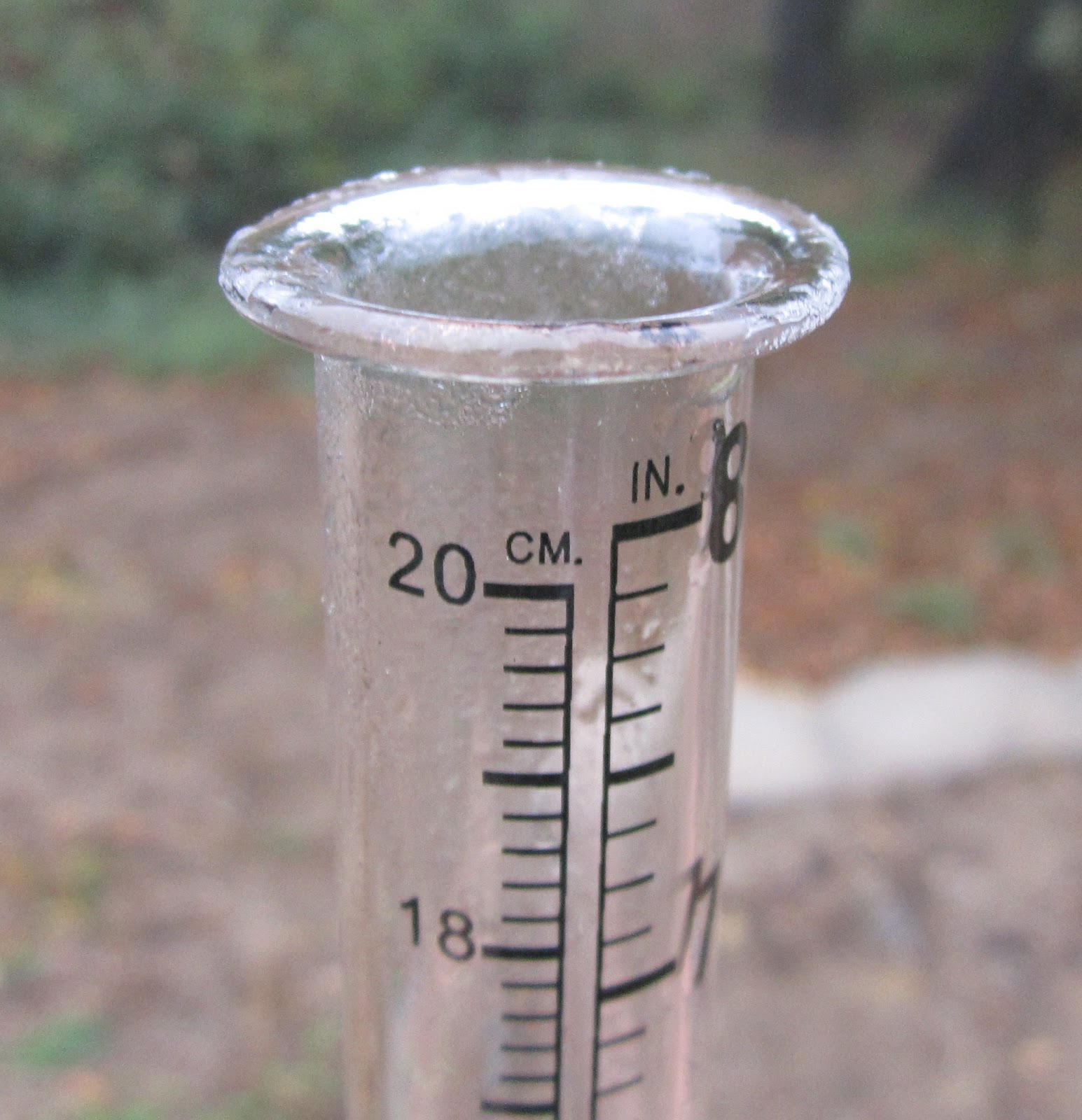
But why is it inaccurate?  Simple... look at the top of the tube, which is what it is hung from in that brass holder:


See that lip?  Much of the rain that lands on it runs into the gauge, but the scale is calibrated only for the inner diameter of the tube.  The net result is that the gauge collects a lot more water than it should given the scale, and the numbers are way off.

And since that lip is curved, I suspect wind has interesting affects too.  If there is no wind as the rain falls it is possible that more of the water that hits the lip winds up in the tube.  if there is wind, though, some may blow off the lip and result in a different - though still inaccurate - reading.  This is speculation on my part, but so far this gauge doesn't consistently read as a multiple of any other gauge, so there is something odd going on.

Anyway, good rain gauges have a knife-like edge at the top to clearly define the collection area, not a hazy, rounded boundary like this one.

I will keep this gauge in the set and collecting data from it though I know it is useless for real record keeping.  It is actually kind of fun to see just how far off it can be.  More than 2X in this rain, obviously, but the range of differences is fascinating to a nerd like me.

There you have it... some information on the various gauges so far.  Interesting to me, at least.  Hopefully you too.

Monday, November 7, 2011

A Man With One Watch...

How many rain gauges does one person need?


Good question, eh?  We are currently comparing five.  Yes, really.

Why?

Well... The amount of rain we get during the rainy season matters to us, since it helps us anticipate how much water we can expect our well to produce during the following Summer and Fall.

In the picture above you can see the yellow plastic one that we have been using for about 19 years. It is starting to degrade due to constant UV exposure over the years, so it will only last so much longer.  In addition, it's only good to 5" rain before it overflows.  Believe it or not we get storm systems that dump more than that on us in 24 or 48 hours regularly, and that makes it inconvenient to deal with on occasion.

My wife bought the 8" rain gauge (with the decorative butterfly) on the right some time back in the hopes that it would give us a better reading on things, but the first few rains it saw - a couple last season and the first two this season - caused us to suspect it is wildly inaccurate.  It regularly read twice what the yellow gauge showed, which caused me to start researching these things.

Eventually I settled on the other three gauges:

The one in the middle is a wedge shape, capable of measuring 6" of rain, with (apparently) high accuracy.  However, accuracy drops as the amount of rain being measured in one shot goes up.

The 6" gauge with bronze numbers is from weather.com, and while it doesn't look any more accurate than the old yellow gauge, the actual accuracy remains to be seen.

And finally the large cylinder on the left is the official gauge that every weather reporting station in the country uses.  It is capable of measuring 12" of rain, snow, or hail with (apparent) great accuracy, but it is harder to read if the total amount is over 1".  A funnel directs rainfall into an interior cylinder, which overflows into the outer cylinder.  The inner cylinder measures amounts up to 1" - easy to read down to 0.01" amounts - but you have to pour out the inner cylinder after reading it, pour the overflow into it, read, add to the total, and repeat until the outer cylinder is empty.  So it is accurate, but not simple to use in a bigger storm.

Anyway, none of these is especially expensive, so I am testing them all, right next to each other, until I know which one(s) we like the most.  Then I will get rid of the others and reduce the set.

Yes, I am insane.  Yes, I am a data nut.  But the only way to know what is going on is to have data, and unless all five gauges are wildly off, I will know in another few weeks which ones I like and why.  I'll provide a detailed report - with numbers - and links to suppliers at that time.

Wednesday, January 27, 2010

Hmmm...

What is that big shiny thing above my head?  The one against the blue background?  And why didn't I get soaking wet while walking the dogs?

Something very strange is going on...

Monday, January 18, 2010

Just waiting for the power to go out

I'm sure it's only a matter of time before the combination of wind, rain, and PG&E causes us to lose power.  But that's yet another result of living on the edges of civilization, rather than in the thick of it.

On a barely related note, why is it that the six year old Siberian Husky with the incredibly thick, luxurious coat is the total wuss and won't go out in the rain?  "No, dad, I can hold it until at least Thursday" seems to be his response to any thought of going outdoors to relieve himself when the ground is wet.  Very strange.

Anyway, I hope you're dry and warm and happy, wherever you are.

Saturday, December 26, 2009

Snow, Snow, Snow...

Four inches at least here in the Chicago suburbs.  Streets are a mess, still, and though the forecast said it was going to be only sporadic snow today, it's basically been continuous.  Yet another example of the inability of anyone to predict the weather with any accuracy.

I hope whatever you're doing for the holidays you're comfortable and happy.  Cheers!

Tuesday, February 24, 2009

How Much Rain?

As many of my readers know, California is in the midst of a three year long drought. Between that and recent economics and politics, it appears to me that everyone is about to die of a massive heart attack. So I thought I'd keep this post light.

This morning we clawed our way to 33" of rainfall so far for the rainy season, which runs from July 1 through June 30 out here. 33" may sound like a lot to some of you, but it's not. If we have no more rain it would be our fourth lowest rain year on record since we moved in back in 1992.

Anyway, as I was writing the numbers down this morning I realized that the only place we have a record of them is on a beat up 3x5 card held to the fridge door with a magnet. That seemed kind of silly. So I put them into a spreadsheet, and actually figured out what the average rainfall in our area has been for 1992 - 2008: 49.59" at our home rain gauge.

So, as you can see, 33" is still well below average, and given we're near the end of February already it's going to be hard to get back to average before the season ends.

Anyway, here are the actual numbers:
  • 1992-1993: 45.75"
  • 1993-1994: 28.80"
  • 1994-1995: 74.50"
  • 1995-1996: 53.55"
  • 1996-1997: 54.70"
  • 1997-1998: 74.70"
  • 1998-1999: 40.85"
  • 1999-2000: 52.70"
  • 2000-2001: 38.85"
  • 2001-2002: 48.95"
  • 2002-2003: 50.80"
  • 2003-2004: 38.80"
  • 2004-2005: 63.00"
  • 2005-2006: 67.80"
  • 2006-2007: 25.35"
  • 2007-2008: 34.35"
May you stay out of drought wherever you live.

Sunday, October 5, 2008

Leaves of Three, Leave it Be...


It's fall, and the poison oak is quite pretty, though many might not believe it possible. This photo was taken a few days too late - the color was quite impressive a bit earlier.

At the moment, both my wife and I are suffering from the rash that accompanies poison oak contact, so we're not big fans of the weed, but when it turns bright red it's quite striking.

The recent storm dropped about an inch of rain in our area, give or take, and the temperatures came down for a while, but warm weather returns in the coming days. Indian summer. But fall really is here, and the weather is changing. I hope we get a lot of rain this winter.

Thursday, October 2, 2008

It's going to rain!

This may seem like a totally mundane thing to those of you living somewhere other than Northern California, but for us, it's not.

You have to understand that it doesn't rain here during the summer. At all. We generally get rain starting sometime in October and if we're lucky we get a steady stream of storms through sometime in April or May. If we're not lucky, we get infrequent storms that don't produce much precipitation.

Living in the Santa Cruz Mountains - where fires have been a problem since last May - we've all grown accustomed to the lack of rain. The native vegetation evolved to live without rain for five or so months in a row, but it still gets awfully dry. So, that first rain of the year is always a welcome relief, even if it isn't enough to end the fire season. Just the smell of rain is wonderful.

Last year our total rainfall was poor - the second lowest total we've recorded in 16 years of living here. The year before wasn't much better. That makes getting a good rainy season this year all that much more important.

I cannot claim that one early storm sets a precedent or establishes a trend, but I hope it does. I'd love to see 70 inches of rain fall this year, and for all the reservoirs to be full to the brim again.

For now, though, I'll take the first rain of the season - assuming it happens on Saturday as currently predicted - and revel in it.

Tuesday, September 9, 2008

Fog! Wonderful Fog!

For the first time in weeks we got fog last night. Deep, thick, serious fog that makes it sound like it's raining outside as it drips off the trees.

It's been way too long since the last time we were fogged in, and every plant out there missed it at least as much as I did.

Now, of course, I have to go walk the dogs in it. Leah may complain, but I won't.

Wednesday, September 3, 2008

Hot hot hot...

Have I mentioned I hate hot weather?

I have less than a month before an art show. There are quite a few things I need to get done before then, but unfortunately every time I go outside to work on something I wilt in the heat.

Someone please turn the thermostat down at least a dozen degrees!

Wednesday, June 25, 2008

Maybe no lightning after all...

The NOAA weather site has dropped the chances of lightning over the weekend. We all know weather forecasts aren;t that great beyond what's happening right now or in the next hour or two, but I'll take this one. This morning we had a 20% chance of thunderstorms on Saturday, Sunday, and Monday. Given the vast number of fires started all over the northern half of California by lightning last weekend, I rejoice to see that vanish off my local forecast.