Showing posts with label mountain_living. Show all posts

Saturday, October 21, 2017

Week 7 of art school

It's hard to believe that I've through seven weeks of the first semester already.

I am already starting to plan my classes for the spring semester. Registration starts pretty soon, and I need to be ready.

In any case, here is what happened last week:

In ceramics, I decided that my project was too plain, so I added a vertical stripe to each piece. This was done with black slip applied over white slip. I hope it looks good after firing, but who knows. This is the pieces all disassembled and continuing to dry in preparation for bisque firing next week:


Nothing is perfect in this work. Things are all slightly askew, in particular, and there is some surface roughness that I am less than entirely happy with. But overall I have hope they will turn out well once they are glazed. The plan remains to glaze them all with a turquoise glaze over the white (and now black) slip. There is also a chance I will instead use different colours on some of the sections, but I am not all that thrilled with the other colour choices available to us in this project. There are seven glazes we can choose from, but two react badly with black slip (making a mess in the kiln and possibly damaging nearby pieces in the process) and one is the same clear we used last time. That leaves just four new glazes that will work in my case. Oh, and we're not allowed to overlap the glazes either, to avoid drips & runs in the firing process.

Art history - AKA Visual Culture I - was another lecture that will be included in the mid-term, which is next week. That will be my first college test in over three decades. The instructor tells me not to worry about it - she says I will do just fine - but no one does these things calmly. I will be fine, I know, but it does add stress.

Painting class this week was another round of life painting, at which I continue to stink - and a very amusing homework assignment. First, though, the best painting from the in class life painting session:


I told you it was pretty bad. That's on paper, as the canvas painting was even worse.

The painting homework this week is to paint something from a song. Any song. It could be what the song makes you see or feel, or it could be a narrative of the song itself. I've got several relatively obscure things running around in my head as a result, and I am not at all sure which I will choose. Or I might get crazy and do more than one. Dunno. Results of that effort will appear here next week assuming they don't stink too.

Design studio gave us a new project: we're building a model of a pavilion for a garden here in Vancouver, based on something to do with insects: their movement, life cycle, etc. We are not, however, supposed to have the pavilion be a giant insect. I've been toying with fireflies, but I am not happy with the things I have come up with so far. As a result, this weekend has me pondering this assignment again. We get a couple of hours in class to work on it this coming week, but it's due at the end of class, so I need this resolved and worked out. Also, he gave us back our grades on the wire model/movement work, and I got another A. Seems like things are going well in that class for me.

Finally we had drawing class yesterday, and we turned in our assignment from last week. That was a triptych in which we setup a still life and did some interesting things we positive vs. negative space. We were working on manila paper with charcoal and chalk or white pastel (or Conté). Here's what I turned in:


And here's what the still life setup for it looked like:


There are some interesting distortions in in, but I am reasonably happy with the results. Apparently the instructor was as well. A perfect score and a request that she be allowed to keep it for a while (along with several others) to put up on display somewhere. The drawing homework for this week is an interior drawing of a house in one point perspective, with something wacky added to it. I have ideas, but I am more worried about other homework due sooner, so it will wait a while.

I'd say that ended the week, but as dinner was ending I was starting to feel a sore throat come on, and it only got worse over night. I appear to have a cold. Not fun.

I did go out and buy an A/V receiver to replace the dead one, so we can once again drive real speakers when watching TV. I haven't completely set it up yet, but we used it last night and it sounded pretty good. Just a cheap Yamaha in this case - last year's model, even - but it will do the job.

In other news, the weather in Vancouver has continued cool and rainy. We keep hearing fairly apocalyptic weather predictions on the CBC radio in the morning: huge storms that will produce 22-50 mm of rain. You do the math, but it's nothing compared to what we experienced in the Santa Cruz Mountains.

And speaking of those, there was a pretty large fire something like seven miles from our old home last week. Called the Bear Fire, it's in really rugged terrain, and in a very odd area where there are a lot of transients and a fair amount of illegal activity. I was in there a few times when I was a member of the VFD, and it's the place where I was famously told by a local that we should not leave the fire engines unattended overnight or they would be stripped clean. Very weird. Anyway, it's currently listed at 391 acres and 50%  contained. CalFire seems to be getting a handle on it. I have stopped worrying about it. I think they finally got a little rain down there as well, which is good.

That ends this week's update, I think. With luck this cold will pass quickly, I'll get painting & design done this weekend, and the art history test will go well. Time will tell.

Thursday, August 15, 2013

A Very Long Night

Last night we went to bed just before 11:30pm. Everyone had settled down - both of us and all three dogs - when that changed. Skookie and Cruzer - our two younger dogs - started barking in the general direction of the street. Odd, but maybe a deer walking around.

Then I noted the flashlights - obviously flashlight beams not car headlights - down on the road. And deer don't carry flashlights, so I got up and looked out the door. I saw two guys (this is from 200+ feet away, in the dark, heavily covered with redwood trees, so no real details were visible) walking the road, like they were looking for something. I watched for a couple of minutes and they seemed to be stuck in front of our house. Clearly on the road, but not walking in either direction along the road. So I let out the dogs. Much barking ensued, but the interlopers did not move on.

I put on a bathrobe, grabbed a flashlight, and stepped out onto my deck. I shined the light down at them and called out, asking if they were "OK down there".

They responded that they were fine, and something along the lines of "don't worry, we're locals".

Really? Somehow that did not engender calm on my side of things. Strangers on the street at 11:30pm, in the woods? Not a normal thing in my 20+ years of living here.

So I called the dogs and went back inside to ponder my options, and watched for several more minutes. The guys eventually started down the hillside on the opposite side of the street, towards a couple of old cabins down there. (I know the property owner... they don't live there, visitors aren't common, and certainly not at that time of night.) They walked down the hill and wandered around the cabins for several minutes. Did I mention it was 11:30pm on a Wednesday night, in the woods, and they clearly weren't the owners of the property, who would have called out to me right away on learning I was awake?

What should I do?

Call the sheriff? Well, yes, but...

  • The response time to my area is forever, probably more than an hour. Even if I called right away these guys would be long gone before the sheriff arrived.  If the sheriff arrived at all.
  • Last time I called about something vaguely like this - someone shooting repeatedly on the same property - I was asked if I "heard screaming or saw blood". I answered "no" but that I could still hear shots being fired, lots of them. And I was unsurprised when the sheriff's office dispatched exactly no one to the scene. Ever. (In the end I think it was someone target shooting, in the woods, in what amounts to a residential neighborhood. Yes, we have big lots up here - you cannot see most of the nearby houses - but still, a very dumb thing to do.)

So what did I do? I got dressed, grabbed my flashlight and cell phone, leashed up the dogs, and went for a walk.

I got to the place where the guys went down the hill and shined my flashlight down at them and waited, up on the road where my wife could hear whatever transpired. I could clearly see their lights down there, moving around the woods.

In a few minutes the guys realized they were being watched and started climbing up the hill towards me. There were actually four of them I then learned, as they spread out a bit on the path. My threat-o-meter went up another notch. just how stupid am I to be down here?

They get to the road and a rather tense conversation ensues. I ask who they are and what they are doing. They tell me they "shot a deer" earlier, are tracking it, and the "last blood" is down the hill.

Well now, isn't that interesting? Suddenly I have a whole new set of worries. Shot? With what? When? In this neighborhood? Are any of you carrying a gun now? Should I be running for my life? Should I just call 911 standing right here? What the *&^% do you think you're doing? But I remained calm - at least on the outside - and said none of that. And I was glad to have two largish dogs on leash with me, one of whom was picking up on how tense the conversation was and growled, as if to make a point.

Instead of panicking, I ask if they own the property - knowing they don't, but wanting to drive the point home. One responds, saying they don't, but that he grew up on a neighboring lot.

I say something like, "Look, it's 11:30 on a weeknight and you guys wandering around here is keeping my dogs - and me - awake." They apologize and say they were just trying to find the deer. Apparently they didn't think about the neighbors. Some agreement is come to - silently... I'm fuzzy on the conversation at this point - and they start walking up the street. I wait until they get out of the way and then go the other way, towards my driveway, with the dogs.

Nothing else exciting happens. I get home just fine, get the dogs off leash, and tell my wife what transpired. The guys have clearly left... the flashlights are gone and you definitely need them down there to avoid tripping and hurting yourself.

It's about 12:45pm. Now we can all get some sleep, right? Alas no.

I get back in bed, but am now too wired and hot to sleep. Not going to happen. So I get out my kindle and start reading.  Anne conks out (good!) and the dogs settle, sort of.

Sometime later - not sure how long... I thought it was about 1am, but I'd clearly been reading for more than 15 minutes - Cruzer throws up. I leapt up in an attempt to get him outside before disaster struck, but was too late. I sent him out anyway and got started cleaning the mess up. That woke Anne up, sadly.

Cruzer actually tried to avoid a problem and managed to throw up in the sliding door track, missing the carpet entirely. Fantastic. But it takes several minutes to clean it out of there, and find more out on the deck and get that cleaned up too. Whee.

Get back in bed, really awake again. Read some more. Cruzer doesn't want to settle, and comes over to my side of the bed, begging for attention, or something. Odd behavior for him, but if he isn't feeling well, it might be explicable. (And remember, I'm not exactly at my best at this point either.)

While reading - first session and second - we have low, loud overflights by (I think) two helicopters and at least one large jet. And when I say low I mean low. Disturbingly so, for the Santa Cruz Mountains in the middle of the night. And rare for our part of the world.

Finally I turn off the kindle and try to get some sleep. It's maybe 2 or 2:30... I'm honestly not sure. And I did sleep, a little, in fits, but not much.

The alarm is going to go off at 7am, so I am not going to get anything like a full night's sleep. Even worse, though, is the canine alarm, which went off at 5:45am. (I think. Can you say "groggy"?)

Both Skookie and Cruzer wanted out. That is very unusual. True, Skookie will always change sides of a door, but she waits until the alarm goes off before making her desires known. And Cruzer is an idiot and sleeps until thrown out or walked, so to have him squeaking at the door is odd. I got up and let them out. No barking. Fine. I went back to bed, waiting for Cruzer to start squeaking that he wanted back in.

But he didn't do that, and I actually dozed a bit more, only getting back up at 6:15am to figure out what had happened to him, since this is definitely not normal behavior. I look out the door and there he is, eating weeds in the dog run. OK... his stomach was bugging him a few hours before, so maybe that's what he needs. But he doesn't ask to come back in. Fine. Leave them out there and go back to bed, hoping for another 45 minutes of slumber.

Ten minutes later Skookie barks at something - probably a deer, but who knows - and I have to get back up and bring them both in before they wake Anne up (again). I managed to accomplish that, and got back in bed, yet again. This night is starting to feel like an exercise program. I wish I was making this up.

The alarm goes off at 7am, as usual. I listen to the news for a while, and then get up to feed dogs and make coffee. On the way to get the dog food I discover that Cruzer has thrown up again sometime in the night, this time down in the laundry room. And his behavior shows me that he is worried about being punished for it, which is something we would never do, but maybe his previous owners did. No way to know. I clean it up. No harm done, but I am keeping an even closer eye on him now.

The dogs follow me upstairs as usual and all go to their food bowls, so I think everything is fine, but as I get started making coffee, Cruzer turns up in the kitchen, long before he usually does. Odd.

I go look at his bowl. It is essentially untouched. He's not eating. This - combined with the other odd behavior and midnight vomiting - has me concerned.

I finish making coffee and get my morning banana. This is something Cruzer lives for: his morning bit of banana. (Honestly.) And he looks at me in something like the usual, expectant way, so I pull a bit off and toss it to him, just as I always do. And it bounces off the top of his head and lands on the floor. He doesn't even turn towards it... just looks at me. This is very wrong.

OK... now what? Anne finishes up her morning stuff, and we start the usual dog walk ritual. This is required every morning. It's not far - Leah, the 14 year old, isn't going far - but it's something, and we have to do it, regardless of anything else going on. It's important. And it's still just as important this morning too, so we head out to the garage to leash up.

And in the process I register just the tiniest little hiccup in Cruzer's stride as he goes down a stair. A back foot is held up just a bit longer than usual. But I am sleepy and unsure and out of it. We walk.

As we start down the driveway I wonder: we're getting some patching done on our driveway, and there is some fresh asphalt down there. Is it possible Cruzer got some of that on his feet last night when we walked down to confront the guys, then licked it off his feet and made himself sick that way? Seems possible. So we decide to change course and not walk on anything with new asphalt on it. Easy to do, and we encounter lots of new smells.

We get down towards the road and there are two guys walking on it. At 8am. Last night's meeting was in the dark, by flashlight, and way too late, but maybe these are two of the guys that were there. So I ask.

Yes, it's them. And they really are sorry about waking us up.

A brief conversation follows - with my wife there - and we learn that they'd shot the deer with an arrow - not a gun, good! - and were still trying to find it. And as much as I hate to say it, they look like hipsters. One has a big, full beard, and at least one had big, thick, dark, plastic rimmed glasses. Hipster hunters, I think. Really. Or so it appeared. (Google it. Turns out to be a real thing.) We said goodbye and kept walking the dogs back towards the house while they kept trying to figure out where their deer had gone.

As we get towards the house I realize that Cruzer is actually limping. Barely, but his right, back leg is definitely not right. We stop, I take Leah's leash from Anne, while she looks at Cruzer's foot. And between two of his pads she found an entire, small, pine cone. Buried so deeply he couldn't get it out himself. That had to hurt.  He probably picked it up in the middle of the night, walking along the road.

And he probably spent all night in pain, possibly trying to dig that thing out from time to time, and the worry (he worries a lot, believe me) made him sick. That's at least as likely as the asphalt theory. And he ate his breakfast when reminded it was there by me drizzling a bit of oil over it to make it more attractive.  Bah.  Poor dog.

As expected, the hipster hunters have wandered off again. I have no idea where their deer went, and apparently they don't either. I hope it isn't suffering.

There ends the story so far. Cruzer and I are getting by on very little sleep. (I, thankfully, have coffee.)

But it is going to be a very long day.

Thursday, June 20, 2013

Yellow Jackets: Scourge of the Earth, or something...

I started to do some mowing and tree trimming on Tuesday. I am trimming up a bunch of trees along the road I live on, as well as mow a field. It all belongs to a neighbor who doesn't mind if I do the work. In fact, I've been mowing this field for him for several years now - to the benefit of us both - and I am finally trying to trim up the trees so they don't rip my face off when I mow under them. And to reduce the ladder fuels as well.

I had been working on to the very first tree on my neighbor's side of the property line for maybe 20 minutes when I felt a sharp pain in my right hip. Inside the pocket. It hurt. A lot.

No sign of the critter, but it had all the hallmarks of a yellow jacket sting. Only then did I note the nest in the ground, not three feet from where I was standing. Grrr.

So I backed off, made sure I wasn't about to die from anaphylactic shock, and kept working, just a bit farther away.

Maybe half an hour later I noted that the inside of my left elbow was starting to itch. Odd... no bites or stings or anything... just a consistent itch. Keep working.

Half an hour after that, though, my elbow is covered with small pustules and swollen up. And itches like mad. Grrr. Again.

Take a break. Wash the elbow clean and examine. No bite or sting marks that I can see. Slather on some topical antihistamine. Examine hip. Clear sting mark and minor swelling. Slather on some antihistamine there too. Start wondering...

Two years ago I was stung by a yellow jacket on my left elbow, just about where it is all swollen now. Could the new sting on my right hip cause the swelling on my left elbow?

The rest of the day goes along without additional excitement. That evening the elbow swelling recedes, but the hip swelling (and pain) increase, then decrease overnight, then increase again the following morning.

And continue increasing during the day. Grrr for a third time.

Finally, despite the fact that I am not obviously dying, I decide to go see a doctor. Mostly about whether the new sting could cause my left elbow to swell than about the swelling in my right hip.

And here's the takeaway from this blog post. Things I didn't know:
  • Less than 1% of people have an allergic reaction to bee stings. That means that unless it itches - or your neck swells up and you cannot breathe - antihistamines don't help. This makes sense in my case. The antihistamine did nothing at all for my hip. Maybe it helped the elbow, but then again maybe not. There is no way to be sure without extensive testing, which given the situation is something I would rather avoid.
  • The doctor says he has never seen an infected bee sting either, and he has seen hundreds of them over the years. That means antibiotics are wasted treatment for them too.
  • The swelling around a bee or yellow jacket sting is actually a reaction to the toxin the little blighter has pumped into your system. It can make your whole arm or leg swell up before it resolves itself, but there is nothing much you can do about it. Maybe some pain killers if it hurts too much, but all that stuff we were taught about allergic reactions and the like: wrong. Unless you're part of that tiny group that actually has one, or you're stung in the mouth.
  • There is no pattern to whether later stings are more or less bad than earlier stings. You never know.
  • Oh, and get the stinger out ASAP if the bee left one stuck in you. Don't worry about squeezing it, just pull the thing out to get it to stop injecting more toxin into your body.
So the doctor told me not to worry about the sting. It will work itself out just fine, and given I hadn't already gone into anaphylactic shock - and the sting site didn't itch - I didn't have an allergic reaction to it. Wait it out is all I can do. OK.

Beyond that, though, my question about whether the new sting could have caused the site of the old sting to swell up and itch was new to him. He didn't know the answer, but said he would try to look it up. It does happen in some cases with poison oak, he knew, so it is at least an interesting question. If I hear anything from him about it, I will share that.

This morning the swelling on my hip is down again. Maybe it will swell back up, maybe not. And the elbow is basically back to normal. Life goes on.

Finally, if anyone knows of a way to render yellow jackets completely extinct - wiped from the face of the earth - with no side effects, please share it. We live with skunks, spiders, bees, wasps, poison oak and maybe scorpions and rattlesnakes (though I haven't seen any of those in 21 years), but yellow jackets are definitely the worst. They all need to die. Now.

Saturday, July 14, 2012

Yellow Jackets Are The Worst

My wife found a yellow jacket nest the hard way this afternoon and was stung three times.  She's fine, but I am keeping an eye on her.

And I will be putting up traps in an attempt to reduce their population.  Nasty things.  I hate them.

Sunday, July 8, 2012

A Friday Night Interrupted


I just sent the following to a local email list... a list of residents of my mountain area.   Figured I'd post it here too, just because someone else might see it and think it over.


Just throwing this out there for others to think about...

Back on Friday night my wife and I were at home, watching a movie.  It was warm-ish, as you may recall, so we had a bunch of doors and windows open.  At about 10:15pm we both just about levitated out of our chairs because we were suddenly overwhelmed with the smell of smoke.  Fresh smoke, not stale, perhaps with some chemical overtones to it.

We checked all around the house, both inside and out.   It was definitely outside, and it was probably coming down the hill from somewhere above us.  We could see no visible column, and there was no wind, so whatever was burning probably wasn't all that close or that large, and it wasn't going anywhere quickly.  I dithered, but I have been explicitly told to call these things in by a Cal Fire captain I trust who used to work at Burrell station.  So after I was sure I had no more detailed information I could report, I did just that.  I hoped the dispatcher would just log the information and see if anyone else called in.  (That way they would have at least one additional data point before sending people out.)  But that isn't what happened, and on thinking about it, they probably aren't allowed to do that.  Get out and find it if you can is the rule, I'm sure.

So at 10:30pm they dispatched the volunteers and Burrell crew to do a smoke check, that is, to go looking for the source of smoke that someone reported.  When I was on the VFD these kinds of calls bugged me a lot.  Not because they were called in - that's fine and good - but because they are difficult to handle.  Even in daylight smoke can be a very hard thing to locate, when you can see it at all.  At night, though, it is much more difficult to find something that has only a smell and almost no way to pin down a visible source.  Still, I was doing what I was told back when I responded to these things, and so were the folks who went looking on Friday night when I caused their pagers to go off.

Burrell station and Loma Prieta both responded.  Two engines crawled the neighborhood for over 30 minutes each.  There was radio traffic saying they smelled it, but they never found the source, and it dissipated over time.  In the end, 5 people from LPVFR and the full Burrell crew both reported it UTL (Unable To Locate) and went back to their normal Friday evenings.  And I am really sorry I dragged them out of whatever they were doing at the time to go on a wild goose chase, but again, that's what I was explicitly told to do.

So why bring this up?  Because something, somewhere, was actually burning.  Someone was using a fireplace, or an outdoor fire pit.  Possibly that someone put something a bit odd on their fire that created the acrid odor.  Whatever the case, that smell caused my wife and I to wonder exactly what was happening, and to call it in.  It was a very strong smell in our house that night at 10pm.

What I would like to ask is to please be considerate of your neighbors in the summer months.  If you do not have to start a fire, please don't.  Smoke drops down to near the ground once it cools off, and it runs downhill, pooling in hollows and valleys.  It definitely doesn't disappear.  If you start a fire, someone below you will be wondering exactly what we were wondering: what is on fire and where is it?  And if there is any wind at all, the worry level only goes up.

Frankly, the same goes for fireworks.  Last night at around midnight I heard a bunch of firecrackers go off somewhere.  While our weather has (wonderfully) been a bit cooler than usual, we're still in high fire danger season, and fireworks of any sort are a serious risk.  Every year I am reminded just how much I hate the 4th of July as things go boom, or even worse, I see colored lights above the local trees.  I know this is obvious, but forest fires kill people and destroy property.  And I know people love fireworks, but this really isn't the place to be setting them off.  Common sense is required.

A quick google search indicates that something on the order of 75% of forest fires are started by people or their equipment in one way or another.  75%.

I'll keep calling these things in when I have to, but I would really like it if that didn't happen when things were dry and the weather is warm.

Thanks.

Sunday, July 1, 2012

Rain Gauges... What Works And What Doesn't

A while back I posted about rain gauges as we started testing some new ones with the goal of figuring out which one(s) we liked and thought were accurate.

Now I have final data for the 2011-2012 rain year I can present my conclusions.  To help with that, here's the original picture of the gauges in question:


From left to right, here's what I measured with each gauge last year and what they are called:
  • 32.86" - A Stratus gauge, 12" capacity
  • 32.15" - A weather.com 6" gauge
  • 33.02" - A wedge shaped 6" gauge
  • 35.20" - Our ancient, yellow, plastic 5" capacity gauge
  • 75.81" - A decorative, glass 8" capacity gauge
I think they were all close enough together for the test that they should have read about the same total rainfall over the season, but clearly there are some obvious differences.  Going through them one at a time, from left to right again, here are my thoughts:
  • The Stratus gauge is far and away the easiest to read if the amount of precipitation is less than 1".  The central tube holds 1" of rain and is easy to read in linear 0.01" increments.  None of the other gauges were nearly as easy to read, nor were they as accurate (as far as I can tell).  That said, however, if the amount of rain goes over 1" it overflows into the outer tube, and the reading process gets more complicated and error prone.  Still, this gauge works very well, and after having used it for a season I trust it.  It's also the standard in use by anyone doing anything serious with the weather as far as I can tell.  There are many places to purchase it.  Here's one, for example: http://www.ambientweather.com/stprraga.html
  • The 6" weather.com gauge read about 2% less than the Stratus gauge.  It is difficult to read in amounts of less than 0.1", so the fact that it was that close is probably due to my rounding readings off in opposite directions enough to even out the error.  There is a fundamental design problem with this gauge, though: it slides into a support that is screwed down, but the wind could blow the gauge right out of that support in some cases.  While I never had that happen, it got close a couple of times.  As a result of those issues I cannot really recommend this gauge.  You can find on amazon.com, though, if you are interested.
  • The 6" wedge gauge presents a mixed bag.  It read only about 0.5% more than the Stratus gauge - essentially the same - but it is hard to read because the markings are small and faint.  Any condensation on the side of the gauge and it is nearly impossible to read without wiping it down, holding it up in the light, and squinting.  It is also the case that the scale isn't linear, so the more it rains the less accurate your reading will be.  And it has only 6" of capacity, so if you're getting a lot of rain you'll be out in it, emptying out the gauge before it overflows.  This is the second best gauge here, though, and for some it may be more than adequate.  It can be purchased from several online vendors, or directly from the manufacturer: Tru-Chek.  It's not particularly expensive either, so consider it if the Stratus isn't to your liking.
  • The yellow 5" gauge is really old, and was a hardware store special back when we bought it 20 years ago.  It read about 7% higher than the Stratus, and though it is heavily embossed and thus easier to read than the wedge, it is marked only in increments of  0.1".  It isn't quite linear either, with a slight taper to the shape.  And finally, the 5" capacity is too limiting if you get heavy rains.  Despite living with it this long I really cannot recommend it, but you can find something essentially identical at amazon.com if you really want one.
  • The butterfly gauge is essentially worthless, having been created by someone who thought they knew how a rain gauge works but actually got all the details wrong.  This gauge read 2.3 times the rainfall logged by the Stratus gauge.  Yes, really.  It's supposed to have 8" of capacity but the impossibly bad design means you actually have less than 4" if you want to bother correcting for it.  I could write a tome about all the things they did wrong with this product, but I'm not going to bother.  Just don't buy it.  Here's a link to a very similar product from the same maker that you can ignore unless all you want to know is that it rained.  (You certainly won't have a clue about how much water actually came down if this is the only gauge you use.)  In short, give this one a wide berth.
So what happens next with our rain gauges?  Well, that's a question...

I need to move the Stratus gauge about 40 feet from its current location.  There are some oak trees nearby that are going to start impinging on the rainfall in particularly windy conditions, so I need to get it out of that area.  But when I do that I don't know how much the new location will affect the totals.  40 feet doesn't seem all that far, but I suspect I need to prove it actually isn't important.

I think what I will do is move the Stratus gauge to the new location and leave the 6" wedge gauge where it currently hangs.  The idea is to use the wedge to cross check the Stratus and see if they continue to read about the same or not.  If I can get through one more year and remain convinced that the 40 foot move hasn't affected things, then I will be done and have only one gauge to work with again.

The other gauges will probably be discarded.  None are worth passing on in my opinion, so I will recycle them.

I'll update rain data on my web site - see the links to the right - as things happen in the new rain year, but I'll probably only record the numbers from the Stratus unless I see big differences between it and the wedge.

A New Rain Year Dawns

Here in California - or at least the bay area - we track our rain annually from July 1 through June 30. That's because our rainy season falls in the winter and spans the new year. If you are trying to figure out how much water the farmers, watershed, reservoirs, and/or water table is going to get, you need to track it around when it falls, rather than splitting it across an artificial date like January first.

So, July 1 marks the start of the 2012-2013 rain year, and the end of our 20th year of collecting rain data at our home.

This year I tested a bunch of rain gauges, and have revised the way I record and display data. I'll write another post about the rain gauges shortly, but first, here are links to the data I have available:
Those pages hosted on my personal web site, where it is easier to make this work than here on Blogger, where column widths make displaying this stuff something of a challenge.

I will provide links to those pages in the right side navigation bar as well, so you can find them in the future without having to find this post.

I leave you to draw your own conclusions from the data. I stress, though, that rain fall amounts vary widely over even small distances, and we have nothing like a statistically valid sample to analyze anything over the long term. We use this data mostly to try and assess how our well will perform over the coming year. If we have less rainfall we can bet we'll our well will low on water before the next rain year gets going and the aquifer can be recharged.

Another thing this data helps us understand is our local fire danger. Rainfall that is well spread out in time keeps the vegetation moist and thus less likely to be a problem. 2011/2012 was the first time I recorded actual rainfall amounts by the day and kept them, so we still have a lot to learn here.

I hope this data is interesting and useful to someone other than me.

Thursday, February 23, 2012

When A Well Pump Dies - Part 2

Sorry... just realized I never told people what happened with the pump.

About $1200 and several days later we had a working well again.  (Those of you who think that owning your own well is an inexpensive proposition should consider that number carefully before committing to it.  Well maintenance is not cheap.)

The best guess at the problem is that the slime (seen in the pictures from the earlier post) built up on the pump to the point that it loaded down the motor.   That might make more sense if you understand something about how at least some well pump controllers work:
  • A float switch in the tank indicates that the tank needs water.  (Our tanks are big - 5000 gallons each - and in theory it takes a bit of a drop before the float switch says the level is low.  In parts of the country with colder weather they don't use storage tanks, but they'd better have good wells that can keep up with demand in that case.)
  • The pump controller turns the pump on via a relay.
  • The pump controller monitors the current drawn by the pump, which starts at one value and changes substantially when the pump runs the well dry.  When that happens, the pump is no longer under load, the controller detects it, and turns it off.
  • Alternately, if you have a good well, the float switch hits the high water mark in the tank and the controller turns the pump off for that reason.
There are other complications, of course, like a timer to let the well recover before the pump is turned on again, but they don't really matter for the purposes of this discussion.

In our case it appears that the slime on the pump made it look as if it was under load - and moving water - even when it had pumped the well dry.  That meant the controller didn't turn the pump off, and since the water is the coolant for the pump, it wound up getting really hot and melting the pipe as previously documented.

The fix mostly involved cleaning the pump.  They bench tested it and found it was still OK, which is good and saved us a lot of money.  We also installed 40' of stainless steel pipe just above the pump to add more heat sink should this ever happen again.

I also get to put chlorine (in the form of bleach) down the well a couple of times a year now to kill off the bacterial slime that builds up and (hopefully) avoid this in the future that way too.

Such fun.  But we have a working well again, and the power bills are back to normal.  (Well, they were back to normal, but then a technician misread our old analog meter while installing a new smart meter, and I'm having PG&E look into that mess, but life moves on.)

May your water always flow.

Thursday, January 5, 2012

When A Well Pump Dies - Part I

Apparently our well pump stopped working a few weeks back.  It takes a while to notice this, though, at least for us.  I have to note the water level in the storage tank dropping.  Also, in this case, and elevated PG&E bill was a giveaway too, though I didn't know that at the time it arrived.

I called our preferred well guy and had him do some diagnosis.  I had already verified that we had power getting to the top of the well and that the pump should have been running, but no water was coming out.  He was able to duplicate my results and noted that the current flowing in the wires meant the pump was probably running.  He bypassed the pump controller and the problem continued, so whatever the issue was it was in the well pump, 380 feet below ground.  Oh joy.

Today he came back with his truck to pull the pump and find out what was going on.  These pictures document that little voyage of discovery.

First, here's what the well head looked like before things got started:


The line on the right (with the gray box) is the electrical supply that drives the pump.  The line in the middle going into the ground is the water discharge.  That goes off to our storage tanks.  The strange looking plastic pipe on the left is a home made sulfur discharge vent, since the old metal one corroded and goobered up the threads it was screwed into.  The first 50 feet of the well is surrounded by concrete to keep ground water from contaminating the well.  Most of that 50 feet has only a couple of inches around it, but the cap has a much wider pad to protect the well head from lawn mowers and the like.

And here we see what it looks like with the well seal opened up and the first couple of feet of pipe extracted:


The electrical was disconnected, the sulfur vent removed, and the union in the water line opened up.  At this point all 380 feet of pipe are hanging from a cable on a truck designed for this purpose.  It looks like this:


That picture was taken a bit later.  You can see a 20' length of schedule 80 PVC pipe hanging from the rig.  The pipes are threaded and attached with brass couplings.  An odd looking device is used to clamp the pipe in place while the section above is disconnected and set aside.  Here's a closer view of that:


The metal thing sitting crosswise at the bottom is the above mentioned clamp.  The technician is using the lift to pull the pipe up.  His assistant is pulling the electrical wires and a safety rope off to the side to keep them out of the way.  (Note that those wires and rope are taped to the pipe at regular intervals, so the tape has to be cut and removed as each pipe is pulled up too.)  Also as the pipe comes up the technician wipes the accumulated slime off of it.  And in our case there is a lot of that slime.  Some combination of iron and sulfur bacteria make for a nasty thick layer of gunk all over everything.  (And there will be a better picture of that later.)

As the end of the 19th section of pipe comes out of the ground, we see the well pump emerge, and just before that, a surprise:


OK... this may not look like much to the uninitiated but that's bad.  Most of the PVC pipe above the pump is 1" diameter.  The last two sections are 1.25" for some technical reason, but they do NOT bow out like that.  That's bad.  That's very bad.

What it means is that sometime a month or more ago the pump ran, pumped all the water out of the well, but then did not turn off.  As it kept running it got hot, since water is the usual coolant for the motor.  As the pump got hot it heated the pipe above the pump got too, and the plastic softened.  Eventually it got so hot - despite there being water inside the pipe - that a hole opened up in the pipe and the water drained out.

So that bowed out area just above the pump is a bad thing.  It means that something is wrong with the pump, the pump controller, or both.  Now, as it happens, we had a long brownout or two just over a month ago during a big wind storm.  For one of them I was home and awake and ran around turning off breakers, though I honestly don't remember if I got the breaker for the well pump or not.  I should have, but who knows.  The other brownout, if it affected us, hit while I was asleep, or so I gather from a neighbor.  The first was something like 20 minutes long and I have no idea about the other, but either might have caused a fault that could result in this sort of behavior.

Or there might be other causes.  Time will tell.

Here's a picture of the entire well pump sitting on the pad around the well:


The top half is the impeller, the bottom half is the motor.  Water enters through the grid in the middle and we can see that isn't too blocked up.

Here's a closer view of the slime from the well and the bottom of the pump.  I hope you haven't eaten recently:


Yeah.  Sorry about that.

And finally, here's the pipe from the well laid out ready to go back in once the problem is fully diagnosed:


The bulge in the last pipe is pretty obvious there.  The large, black, football shaped thing two pipes over from the left is a torque arrestor, to keep the pipes from twisting and banging around when the motor kicks in.  It fits just inside the six inch plastic pipe that lines the well.

My well guy took the pump and controller off with him today.  He will clean up the pump, bench test it all, and find the problem.  If the controller is bad he will replace it.  In addition - since this is the second time we've seen that pipe bulge up due to a hot pump - he may replace the last 20' section of PVC with stainless steel, to reduce the chances of that happening again.  (Of course, if it does happen the stainless will conduct heat better, and it might just move the problem, or it might cause the pump to burn out once it has run too long.)

Hopefully tomorrow he will be able to tell me exactly what failed, and we can start looking to avoid the root cause of the problem.  That may mean trying to find some way to protect our entire home from brownouts.  We already have a whole house surge protector installed, but nothing keeps a brownout from crippling us.

More when we know it.  Whee.

Sunday, November 20, 2011

Dumber than a box of rocks...

Yes, I am.  Really.

In this post I discussed some surprising rainfall numbers.  Turns out, though, I totally misread the official rain gauge.  It seems that 0.20" and 0.02" are very different numbers. Go figure.

sigh

So... overall, this means that things are more-or-less normal with the gauges.  The evaporation issue is still real, and the butterfly gauge still reads a lot more than the others.

I will go hide now.  Well, once I get a disclaimer on that original post.  The spreadsheet has been updated to reflect reality.

Saturday, November 19, 2011

Unexpected Rainfall Numbers

UPDATE ON 11/20/11: this post contains an error of vast and troubling proportion: 0.20" is not the same as 0.02".  Yours truly apologizes and retracts it here.

We had something that might have been called rain yesterday.  It was very tiny drops, off and on, for hours.  My wife might have called it "measurable fog."  It was still going after dark so I left reading the gauges for this morning.  The results, though, are a surprise:
  • The "official" gauge - the one I trust the most so far - read 0.20".  That seemed to make sense to me on the level of gut feel.  Everything was wet for some time yesterday.
  • The old yellow, weather.com, and wedge gauges, though, were all either empty or showed just a trace.  Nothing measurable in any of them.
  • The butterfly gauge - which usually reads at least twice what the others claim - contained just 0.10".
How to explain that?

Well, my best guess is that we had plenty of evaporation overnight.  Things were dryish this morning, which means the water went somewhere.  And the three gauges that had only a trace also have the largest openings, making it easy for evaporating water to escape.

The butterfly gauge had more in it earlier in the day, yesterday, than 0.10".  I noted it in the afternoon when I picked up the mail, but I wasn't taking readings as it was still raining at the time.  So it must have evaporated out of there.  No one emptied it, I know that.

The official gauge is interesting.  Because it is a small cylinder enclosed in (and protected by) a larger cylinder, and since there is a funnel covering most of the interior cylinder and all of the outer cylinder, I suspect evaporation is slower.  It's a pretty small hole for the water to evaporate out of in any case, so while it can happen, it takes more time.

In short, though it seems counter intuitive, I think the official gauge wins again, and that it is design flaws in all the others that made them read too low this time around.

Not what I anticipated - particularly with the butterfly gauge - but it makes sense.

The spreadsheet has been updated with the new numbers.

Wednesday, November 16, 2011

Rain Data Now Available

So... just because a few may be interested, I have added a link to get a PDF version of the current rain totals for my home to the right hand column of this blog.  I keep the data in google docs and Google claims it gets updated within five minutes of any of my changes to the underlying spreadsheet.

This way you don't have to ask if you care.  Just go to http://powelltriangle.blogspot.com/ and click on the link.  You can see how the various gauges compare and what the total rainfall for the season is so far.  Interesting, eh?

That link, by the way, is also right here.

I should also link to the two earlier posts about this silliness:
Those posts document what I am doing and why.  Necessary background material if you are going to understand this particular oddity of my behavior.

Saturday, November 12, 2011

Rain Gauges - actual data from actual rain

As per the earlier post about rain gauges we are testing several to see how they compare.  While this isn't a scientific test, it is fun, and some people even expressed interest in it.  We had some rain yesterday, so I took pictures of the gauges this morning as I read them, and figured I'd write that up.  In summary, and in order of apparent accuracy, the gauges read:
  • 0.33" - official gauge
  • 0.32" - wedge shaped gauge
  • 0.3" - old yellow gauge
  • 0.3" - weather.com gauge
  • 0.8" - butterfly gauge
Below are the pictures of each one with some comments.

The "official" gauge, which I keep wanting to (incorrectly) call the NOAA gauge:


What you see here is the easiest gauge of all to read if the total amount of rain is less than one inch.  I didn't even remove it from the mounting bracket or pull out the central tube.  All I did was wipe the outside of the big cylinder to get rid of the condensation, point the camera, and click.  0.33" is pretty simple to read, don't you think?

Note the bird dropping in the bottom of the tube.  That might add a tiny bit too much to the total, but much less than the accuracy of 0.01", so I ignored it.  The funnel has a diameter of three or four inches, so stuff like this will fall in from time to time.

Also note that the scale on the central tube is simple and linear.  Very easy to read, and the meniscus is easy to see, even through the outer tube.

The only problem with this gauge is what happens when you have more than one inch of rainfall.  It overflows into the outer tube and you have to pour it into the central tube in portions to get the total amount.  Accuracy is still good, but convenience is not.  Then again, it can measure up to 12 inches of rain in one shot that way, which is better than anything else I've found so far.

The wedge gauge:


This is the bottom of the wedge shaped gauge.  I'm not quite holding it vertically in the picture, but it claims 0.32" of rain when held properly.

Looks a bit hard to read, don't you think?  It is, for a few reasons.

First, the embossed numbers are pretty small.  If you need reading glasses in general, you will need them to read this gauge.  Not so nice if it's still raining when you're trying to read it.

Second, the embossing isn't all that pronounced.  Getting it to show in the picture was tough.  (You can click on the picture to see the full sized view, which helps, but it still isn't easy to read.)

Third, there is no paint on the embossing.  that would make this a lot easier to read, but also add to the manufacturing costs.

Finally, and most critically in my opinion, the scale on this gauge is not linear.  Since it is wedge shaped there are places where the embossed numbers change from what you might expect.

Here's the same picture that I have hand edited in an image editor to make the English scale more obvious.


Note the numbers getting closer together as you head up the gauge.  Also note that we go from increments of 0.05" to 0.1" after the 0.2" mark.  And there are other places where similar changes happen farther up the gauge.

Reading this one isn't nearly as simple as it should be.

Accuracy is probably pretty good.  The difference between 0.33" and 0.32" is pretty much in the noise range.  Most if not all of this rain fell yesterday and in the evening, but the gauges sat out in the fog all night before they were read.  If the wedge gauge collects less fog than the official gauge, it might read slightly less just for that reason, for example.

Anyway, some paint would sure help this one.

The Old Yellow gauge:


This is the 19 year old gauge we've been using all along.  It's nice and simple, but as you can see it's a bit hard to read.

If you remember your chemistry class, though, you read the bottom of the meniscus, so that (when held vertically) is about 0.3" of rain.

The embossing is easier to read on this one than on the wedge, but still no paint.

And don't plan on reading this to anything more accurate than 0.05".  Even that is a guess in most cases, since even the slightest tilt of your hand will move the meniscus around a fair bit.

The weather.com gauge:


This gauge has a strange combination of things that make me wonder about it.

The large numbers on the front (1, 2, etc) are painted and embossed, but useless for anything except to remember which inch you're "in" when reading the thing.

The lines on the sides are painted only - not embossed - which means that they will flake off and the gauge will be unreadable as soon as the sun does it in.

When held vertically - which I am not quite doing in the picture - the meniscus was right at 0.3".  Like the yellow gauge, though, reading anything other than 0.05" increments isn't going to happen.

In all I am not sure why weather.com put their name on this thing.  I suspect a season or two and it will be unreadable, and I wonder about its accuracy.  Determining that will require a storm that gives us 3 or 4 inches of rain, so the linearity of the scale and the accuracy of the painted lines can be compared with the official and wedge gauges.

The butterfly gauge:


This is the last - and least accurate - gauge.  Though it is hard to tell from the image that tube is held just about vertically, and yes it really claims we got 0.8" of rain, where the others all said 0.3" - 0.33". 

Like the weather.com gauge, the marks on the tube are only painted on, not embossed.  That, however, is because the tube is made of glass, not plastic.  Kind hard to emboss glass like this on the cheap.

The paint will, no doubt, come off with enough UV exposure, so it would probably be useless in a couple of seasons, even it it wasn't wildly inaccurate, which makes it effectively useless now.

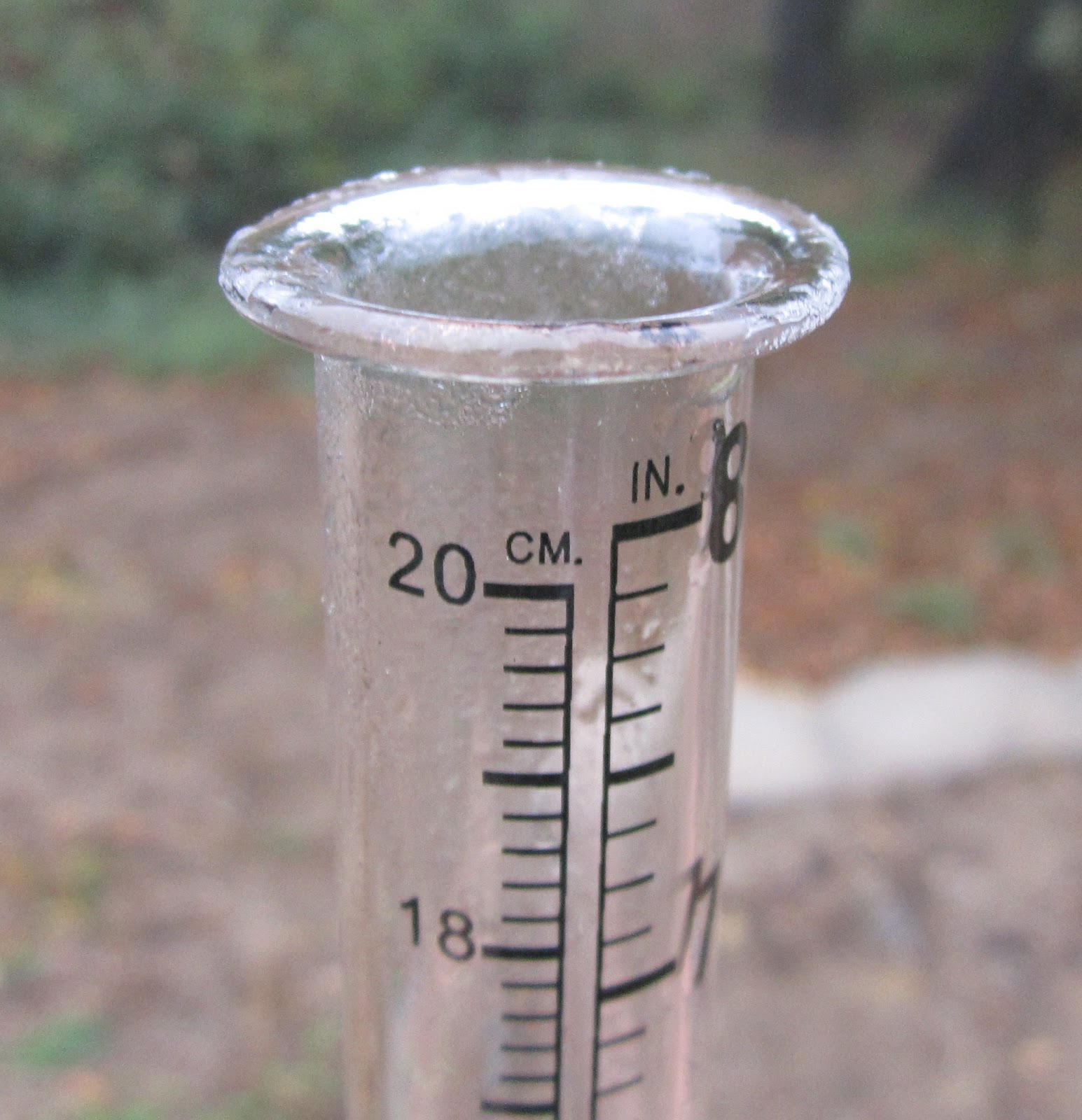
But why is it inaccurate?  Simple... look at the top of the tube, which is what it is hung from in that brass holder:


See that lip?  Much of the rain that lands on it runs into the gauge, but the scale is calibrated only for the inner diameter of the tube.  The net result is that the gauge collects a lot more water than it should given the scale, and the numbers are way off.

And since that lip is curved, I suspect wind has interesting affects too.  If there is no wind as the rain falls it is possible that more of the water that hits the lip winds up in the tube.  if there is wind, though, some may blow off the lip and result in a different - though still inaccurate - reading.  This is speculation on my part, but so far this gauge doesn't consistently read as a multiple of any other gauge, so there is something odd going on.

Anyway, good rain gauges have a knife-like edge at the top to clearly define the collection area, not a hazy, rounded boundary like this one.

I will keep this gauge in the set and collecting data from it though I know it is useless for real record keeping.  It is actually kind of fun to see just how far off it can be.  More than 2X in this rain, obviously, but the range of differences is fascinating to a nerd like me.

There you have it... some information on the various gauges so far.  Interesting to me, at least.  Hopefully you too.

Monday, November 7, 2011

A Man With One Watch...

How many rain gauges does one person need?


Good question, eh?  We are currently comparing five.  Yes, really.

Why?

Well... The amount of rain we get during the rainy season matters to us, since it helps us anticipate how much water we can expect our well to produce during the following Summer and Fall.

In the picture above you can see the yellow plastic one that we have been using for about 19 years. It is starting to degrade due to constant UV exposure over the years, so it will only last so much longer.  In addition, it's only good to 5" rain before it overflows.  Believe it or not we get storm systems that dump more than that on us in 24 or 48 hours regularly, and that makes it inconvenient to deal with on occasion.

My wife bought the 8" rain gauge (with the decorative butterfly) on the right some time back in the hopes that it would give us a better reading on things, but the first few rains it saw - a couple last season and the first two this season - caused us to suspect it is wildly inaccurate.  It regularly read twice what the yellow gauge showed, which caused me to start researching these things.

Eventually I settled on the other three gauges:

The one in the middle is a wedge shape, capable of measuring 6" of rain, with (apparently) high accuracy.  However, accuracy drops as the amount of rain being measured in one shot goes up.

The 6" gauge with bronze numbers is from weather.com, and while it doesn't look any more accurate than the old yellow gauge, the actual accuracy remains to be seen.

And finally the large cylinder on the left is the official gauge that every weather reporting station in the country uses.  It is capable of measuring 12" of rain, snow, or hail with (apparent) great accuracy, but it is harder to read if the total amount is over 1".  A funnel directs rainfall into an interior cylinder, which overflows into the outer cylinder.  The inner cylinder measures amounts up to 1" - easy to read down to 0.01" amounts - but you have to pour out the inner cylinder after reading it, pour the overflow into it, read, add to the total, and repeat until the outer cylinder is empty.  So it is accurate, but not simple to use in a bigger storm.

Anyway, none of these is especially expensive, so I am testing them all, right next to each other, until I know which one(s) we like the most.  Then I will get rid of the others and reduce the set.

Yes, I am insane.  Yes, I am a data nut.  But the only way to know what is going on is to have data, and unless all five gauges are wildly off, I will know in another few weeks which ones I like and why.  I'll provide a detailed report - with numbers - and links to suppliers at that time.

Sunday, August 28, 2011

Up on the roof

When we had our house painted - last January, for reasons I won't go into here - we had all the seams in the vertical siding caulked up.  (Vertical siding is a PITA.  Yet another lesson learned only after buying a house with that particular "feature".  But I digress.... )  When the spring came, though, and the siding dried back out, a lot of the seams popped open, which looked ugly and was going to let water into places I didn't want it.   So a major project to complete before the rains return is to recaulk and repaint all the seams that opened up.

Most of that effort involves only paint, a brush, and a ladder of one sort or another, but there is one wall over a fairly steeply pitched roof which took a bit more care.


That roof is shingled with Hardishake (another product that sounds a lot better than it actually works out to be, sadly, and another lesson learned only after buying a house using it, but again I digress.  Oh, and the picture shows day two of the effort.   I have already been up there to recaulk the seams, but yet again I digress.)  Hardishake is slippery and fragile, so climbing on that slope without safety gear seemed like a bad idea.  The above picture shows the roof with that gear in place.  Here's what it looked like to my wife, from the ground, while I was working up there:


That's about a 10 foot fall off the roof onto concrete - if it happens - and I really wanted to avoid that particular fate.  Alas I am not a professional climber of any kind and my gear is pretty limited.  I have two good - but not locking - carabiners, some cheap rope, some nylon webbing, and I bought a climbing harness specifically for this job.  That's it.

The rest of this writeup is for Chief Alex, who wanted to see pictures of what inanity I was doing to keep myself from being his next 911 response.  The rest of you may wander off or read on as you see fit now that you've seen the above pictures.

First, I anchored my safety rig to the house, around a half inch threaded rod that is exposed and goes through multiple redwood beams before being held in with nuts & washers.  Two independent webbing anchors (orange and yellow in the picture below) are tied with doubled webbing on either side of the beam.  Each terminates in a loop tied with something similar to, but not actually, a figure 8 knot and several safety knots.  Through those two loops I tied in my safety ropes.  I had only one, but it is 100' long, so I doubled it, and tied a figure 8 knot - the world's ugliest, I admit - with a loop that went through the loops in the webbing, and then a safety not or two and then tape.  Here's the resulting mess:


The webbing anchors look like this up close:


It's not obvious - our house is an architectural oddity - but the beam and threaded rod seen above are about eight feet above a flat roof, so I can easily get there to do the setup.  Then the lines go up and over onto the roof you cannot see from those pictures, and trail down on the shingled side as seen in the first picture above.  A pad is put over the corner of the roof just above the beam to protect the ropes.  Next I put on my climbing harness and clipped in like this:


Note that each rope is paired, and that each pair ends in a figure 8 knot with a loop and a safety knot.  The white and green tape seen above was for me to track which was which if needed, and each loop is really a pair of loops, so it's all redundant.  The carabiners clip each of the loops to the harness independently.

The goal was that for nearly all the time I was working any one thing could fail and nothing bad would happen.  If I lost a webbing anchor, I had a spare.  If I lost a single rope, it was doubled to the harness.  If I lost both ropes in a pair, I had a spare pair to catch me.

As the second picture shows, the risk was that I could slip, fall, and slide off the roof.  What I needed was something to stop my slide if that happened, rather than catch my full weight on a vertical drop.  The rig I arranged managed to do exactly that, and gave me an extra bit of leverage to move around on the roof with.

A challenge was that I had 15 feet of wall I am painting, and I had to move up or down the length of the wall as I worked on it.  I managed that with the dual, paired lines.  When needed I could move uphill a bit, unclip one of the lines, tie a temporary knot with a loop in it, and clip back in on that loop as well as the end loop.  That let me keep the rope short so that if I fell I would only slide a foot or two before stopping.  And, of course, I could work the other way, starting at the top with two shorter, temporary attachment points, work, then lengthen the ropes one at a time, always being clipped in to one or the other while doing so, then moving down the roof and working some more.

The biggest risk - I think - is that I was using non-locking carabiners, and that when I unclipped from one line to reset the length I was left on a single carabiner.  At all other times I think everything was at least doubled up.  Well, I suppose the harness itself counts as a single point of failure, but it's built to take some strain.

Anyway, the work on the sloped roof is done now except for putting a ladder up to sweep the debris down with a broom.  No more walking on fragile shingles.  I already had to glue a bunch back together as a result of this excursion and numerous others that have been done by painters, roofers, Internet connection installers, and exterminators over the years.

Thanks to Chief Alex for his training when I was part of the VFD - even if I only remember a fraction of it now - so that I could setup a system that let me get this job done with confidence and some measure of safety.  He would have done it very differently, I know, but given what I had to work with I think I did OK.

Lots more projects remain to be done before the rains get here, but I don't think anything will require this sort of rig again.  

Monday, January 18, 2010

Just waiting for the power to go out

I'm sure it's only a matter of time before the combination of wind, rain, and PG&E causes us to lose power.  But that's yet another result of living on the edges of civilization, rather than in the thick of it.

On a barely related note, why is it that the six year old Siberian Husky with the incredibly thick, luxurious coat is the total wuss and won't go out in the rain?  "No, dad, I can hold it until at least Thursday" seems to be his response to any thought of going outdoors to relieve himself when the ground is wet.  Very strange.

Anyway, I hope you're dry and warm and happy, wherever you are.

Sunday, October 25, 2009

Another Fire Near My Home

Despite over 13 inches of rain just a bit over a week ago, fire season is definitely not over. Very early this morning a fire broke out near the site of the Summit Fire that caused so much grief and damage last year.

As of this writing the fire is listed at 800 acres in size and either 0% or 5% contained, depending on the source you're reading. The local school just a mile or two north of us is being used as a helipad, so we've had a constant stream of helicopters landing and taking off there all afternoon.

Like last year, the fire is east of us by a few miles. Based on the smoke I can see, the prevailing winds are blowing south, also like last time. However, unlike last time, I've seen written reports that the first is moving west. If it is doing so it is moving slowly, and it's happening because of terrain, not wind. Still, west is towards us, and those reports have me slightly worried.

The bigger worry, though, is wind. I've got an email from the weather service saying the entire bay area is going under a high wind watch on Monday night. They're expecting northerly winds of some speed. That would not drive the fire towards our home, but it would be nasty for those in the path and those working the blaze.

In any case Anne and I are just fine at the moment, and we're keeping a careful eye on things. If I was responding with the VFD I'd probably be at the station, ready to respond to any other incidents that come up, though it is possible I'd be on the fire line itself. When the pager goes off at 3:30am you do what you're told, and I have no way of predicting exactly where I'd be.

For those wanting more information, the best sources of news I've found so far appear to be:

http://calfire.blogspot.com/

and

http://cdfdata.fire.ca.gov/incidents/incidents_details_info?incident_id=402

The former appears to be updated more often, but isn't official. The latter is definitely official, but only gets updated once or twice a day.

This one is called the Loma Fire. If I get any major news about it I'll share it here. Hopefully, though, things are under control relatively quickly and things get back to normal.

Thursday, February 19, 2009

Mountain Living - Water Part XI

Another in the ongoing saga of our water woes...

Now we have a 5000 gallon tank full of mud.

Well, that's a bit hyperbolic, but still somewhat factual. The other day I noted that the water in the dog's dish was slightly brown. Wondering about that I did some research and discovered that all the water in the house was that color except what comes from the RO unit.

So I wandered out to the water tanks to see if anything was up out there. Oh yeah. Suspended silt in the water. Probably the result of two years of drought and then finally getting some water into the water table this year. Cruft is getting dislodged and washed out into our well. Fun!

Eventually I think it will settle out, but it will take time. And in the meantime it's ugly. I backwashed the filters and things are better now, but it's not pretty out there.

Once again I repeat for those who hate city water: you have no idea how good you've got it. Just pay your bill and quit complaining.

At the moment I am waiting for referral information on how to build my own sand based turbidity filter that might help with this (and other) water quality problems. We'll see if that ever shows up or not. And in the meantime I'll keep asking the oracle.

Tuesday, February 3, 2009

Mountain Living - Water Part X

This isn't the water related post I expected it would be.

As those following the water saga know, we've been buying water lately as the production from the well has tapered off. Not fun, but necessary.

Well, sometime in the last week or two, that changed. The tanks are now full. On their own. I just talked to my wife who told me that they are "full, full", not just "full". Interesting.

This sort of thing has happened in the past thanks to minor earthquakes which - I think - break up the silt and calcification that clog up the paths the water takes to get into the well. But we haven't had any quakes I know of in our area recently. A few 4.x sized things down near Hollister and Gilroy, maybe, but nothing in our neck of the woods.

Perhaps some of our highly limited rain has finally made its way into the water table, and thus is now available as water in our well. Who knows.

In any event it appears we won't have to buy more water for a while. Go figure.

Wednesday, November 12, 2008

Mountain Living - Water Part IX

The water heater is finally working again.

No, you haven't missed any earlier articles about the problem. I've been pretty busy of late, as this came to light as I was getting ready to go back to work.

We have an all electric house, so (of course) our water heater is electric. Years ago we replaced a standard unit with a non-metallic one, as that keeps the sulphur bacteria from growing in the tank. I like that choice, but may get a tankless unit later. Time will tell.

In any event, things got interesting with the water heater a couple of weeks ago. It stopped producing hot water, and eventually I found that it was tripping the circuit breaker at odd intervals.

Eventually I determined that one thermostat was bad, as it was only passing 120 volts (instead of 240) to the lower heating element. I ordered replacement thermostats - both upper and lower - installed them, and found that didn't solve things. Additional research convinced me that the lower heating element was also bad and shorting out. Then my friend Alan figured out that the new upper thermostat I'd been sent was bad too.

While I waited for parts to arrive I disconnected the lower heating element to avoid the short, used one of the broken upper thermostats, and turned the water heater on with the circuit breaker only when we needed it. That wasn't exactly an approved - or convenient - solution, but it worked. Thankfully we didn't have to do it for long.

In the end - two heating elements and a replacement for the replacement thermostat later - I've finally got it working properly. It turns out the lower heating element had corroded to the point that it had sheared off entirely inside the tank. That caused the short that tripped the breaker, so all the obvious failures are explained now.

A less than obvious thing is also explained. For some time we had a lot of air in the hot water lines. I couldn't figure out why that was, but now I know that the broken heating element was turning water into hydrogen and oxygen gas right there inside the tank. Exciting, eh?

At this point I can assure you that a functioning water heater is a very good thing, and I'm glad to finally have one again.