Showing posts with label rain_gauge. Show all posts

Sunday, July 1, 2012

Rain Gauges... What Works And What Doesn't

A while back I posted about rain gauges as we started testing some new ones with the goal of figuring out which one(s) we liked and thought were accurate.

Now I have final data for the 2011-2012 rain year I can present my conclusions.  To help with that, here's the original picture of the gauges in question:


From left to right, here's what I measured with each gauge last year and what they are called:
  • 32.86" - A Stratus gauge, 12" capacity
  • 32.15" - A weather.com 6" gauge
  • 33.02" - A wedge shaped 6" gauge
  • 35.20" - Our ancient, yellow, plastic 5" capacity gauge
  • 75.81" - A decorative, glass 8" capacity gauge
I think they were all close enough together for the test that they should have read about the same total rainfall over the season, but clearly there are some obvious differences.  Going through them one at a time, from left to right again, here are my thoughts:
  • The Stratus gauge is far and away the easiest to read if the amount of precipitation is less than 1".  The central tube holds 1" of rain and is easy to read in linear 0.01" increments.  None of the other gauges were nearly as easy to read, nor were they as accurate (as far as I can tell).  That said, however, if the amount of rain goes over 1" it overflows into the outer tube, and the reading process gets more complicated and error prone.  Still, this gauge works very well, and after having used it for a season I trust it.  It's also the standard in use by anyone doing anything serious with the weather as far as I can tell.  There are many places to purchase it.  Here's one, for example: http://www.ambientweather.com/stprraga.html
  • The 6" weather.com gauge read about 2% less than the Stratus gauge.  It is difficult to read in amounts of less than 0.1", so the fact that it was that close is probably due to my rounding readings off in opposite directions enough to even out the error.  There is a fundamental design problem with this gauge, though: it slides into a support that is screwed down, but the wind could blow the gauge right out of that support in some cases.  While I never had that happen, it got close a couple of times.  As a result of those issues I cannot really recommend this gauge.  You can find on amazon.com, though, if you are interested.
  • The 6" wedge gauge presents a mixed bag.  It read only about 0.5% more than the Stratus gauge - essentially the same - but it is hard to read because the markings are small and faint.  Any condensation on the side of the gauge and it is nearly impossible to read without wiping it down, holding it up in the light, and squinting.  It is also the case that the scale isn't linear, so the more it rains the less accurate your reading will be.  And it has only 6" of capacity, so if you're getting a lot of rain you'll be out in it, emptying out the gauge before it overflows.  This is the second best gauge here, though, and for some it may be more than adequate.  It can be purchased from several online vendors, or directly from the manufacturer: Tru-Chek.  It's not particularly expensive either, so consider it if the Stratus isn't to your liking.
  • The yellow 5" gauge is really old, and was a hardware store special back when we bought it 20 years ago.  It read about 7% higher than the Stratus, and though it is heavily embossed and thus easier to read than the wedge, it is marked only in increments of  0.1".  It isn't quite linear either, with a slight taper to the shape.  And finally, the 5" capacity is too limiting if you get heavy rains.  Despite living with it this long I really cannot recommend it, but you can find something essentially identical at amazon.com if you really want one.
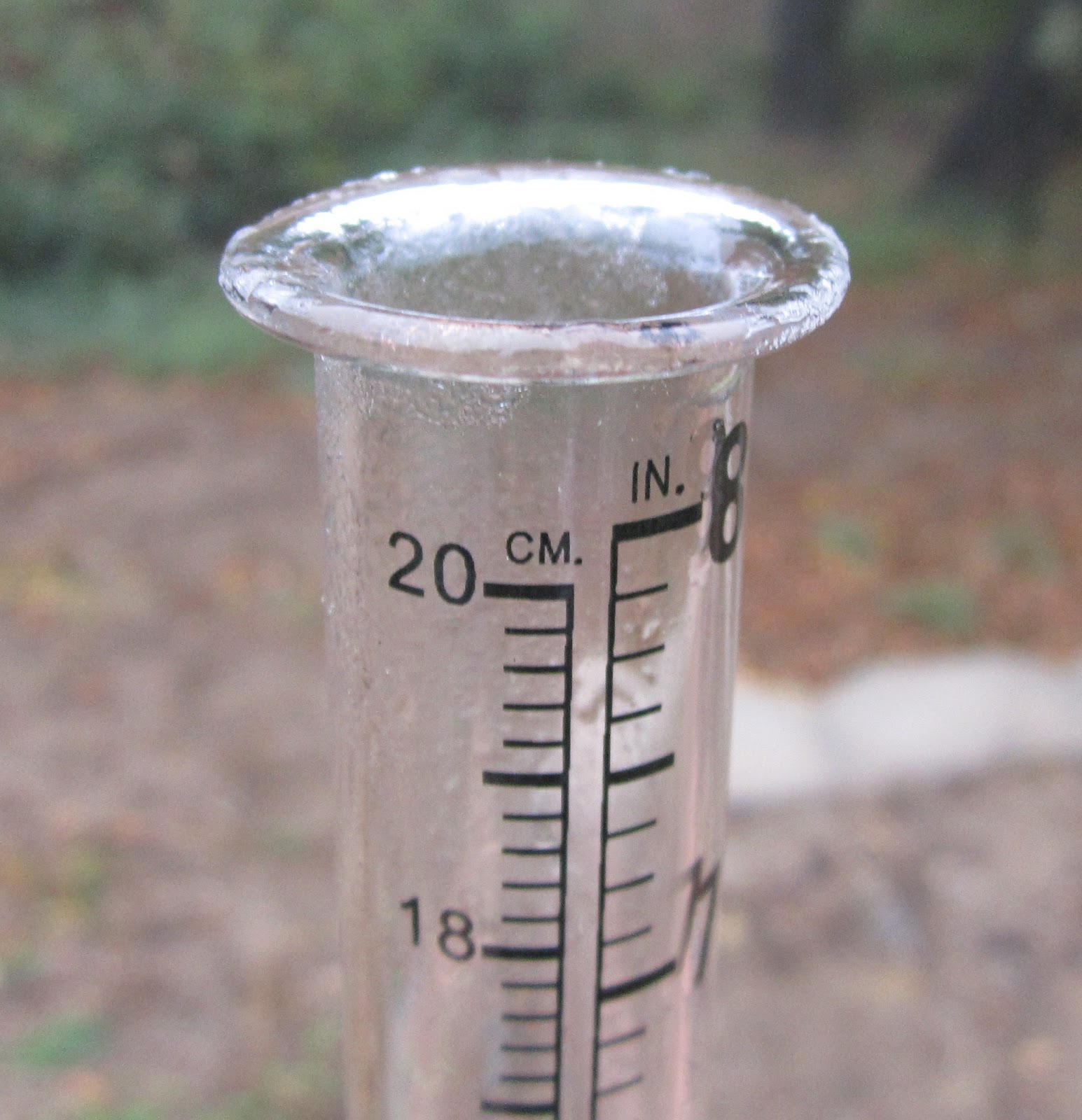
  • The butterfly gauge is essentially worthless, having been created by someone who thought they knew how a rain gauge works but actually got all the details wrong.  This gauge read 2.3 times the rainfall logged by the Stratus gauge.  Yes, really.  It's supposed to have 8" of capacity but the impossibly bad design means you actually have less than 4" if you want to bother correcting for it.  I could write a tome about all the things they did wrong with this product, but I'm not going to bother.  Just don't buy it.  Here's a link to a very similar product from the same maker that you can ignore unless all you want to know is that it rained.  (You certainly won't have a clue about how much water actually came down if this is the only gauge you use.)  In short, give this one a wide berth.
So what happens next with our rain gauges?  Well, that's a question...

I need to move the Stratus gauge about 40 feet from its current location.  There are some oak trees nearby that are going to start impinging on the rainfall in particularly windy conditions, so I need to get it out of that area.  But when I do that I don't know how much the new location will affect the totals.  40 feet doesn't seem all that far, but I suspect I need to prove it actually isn't important.

I think what I will do is move the Stratus gauge to the new location and leave the 6" wedge gauge where it currently hangs.  The idea is to use the wedge to cross check the Stratus and see if they continue to read about the same or not.  If I can get through one more year and remain convinced that the 40 foot move hasn't affected things, then I will be done and have only one gauge to work with again.

The other gauges will probably be discarded.  None are worth passing on in my opinion, so I will recycle them.

I'll update rain data on my web site - see the links to the right - as things happen in the new rain year, but I'll probably only record the numbers from the Stratus unless I see big differences between it and the wedge.

Sunday, November 20, 2011

Dumber than a box of rocks...

Yes, I am.  Really.

In this post I discussed some surprising rainfall numbers.  Turns out, though, I totally misread the official rain gauge.  It seems that 0.20" and 0.02" are very different numbers. Go figure.

sigh

So... overall, this means that things are more-or-less normal with the gauges.  The evaporation issue is still real, and the butterfly gauge still reads a lot more than the others.

I will go hide now.  Well, once I get a disclaimer on that original post.  The spreadsheet has been updated to reflect reality.

Saturday, November 19, 2011

Unexpected Rainfall Numbers

UPDATE ON 11/20/11: this post contains an error of vast and troubling proportion: 0.20" is not the same as 0.02".  Yours truly apologizes and retracts it here.

We had something that might have been called rain yesterday.  It was very tiny drops, off and on, for hours.  My wife might have called it "measurable fog."  It was still going after dark so I left reading the gauges for this morning.  The results, though, are a surprise:
  • The "official" gauge - the one I trust the most so far - read 0.20".  That seemed to make sense to me on the level of gut feel.  Everything was wet for some time yesterday.
  • The old yellow, weather.com, and wedge gauges, though, were all either empty or showed just a trace.  Nothing measurable in any of them.
  • The butterfly gauge - which usually reads at least twice what the others claim - contained just 0.10".
How to explain that?

Well, my best guess is that we had plenty of evaporation overnight.  Things were dryish this morning, which means the water went somewhere.  And the three gauges that had only a trace also have the largest openings, making it easy for evaporating water to escape.

The butterfly gauge had more in it earlier in the day, yesterday, than 0.10".  I noted it in the afternoon when I picked up the mail, but I wasn't taking readings as it was still raining at the time.  So it must have evaporated out of there.  No one emptied it, I know that.

The official gauge is interesting.  Because it is a small cylinder enclosed in (and protected by) a larger cylinder, and since there is a funnel covering most of the interior cylinder and all of the outer cylinder, I suspect evaporation is slower.  It's a pretty small hole for the water to evaporate out of in any case, so while it can happen, it takes more time.

In short, though it seems counter intuitive, I think the official gauge wins again, and that it is design flaws in all the others that made them read too low this time around.

Not what I anticipated - particularly with the butterfly gauge - but it makes sense.

The spreadsheet has been updated with the new numbers.

Wednesday, November 16, 2011

Rain Data Now Available

So... just because a few may be interested, I have added a link to get a PDF version of the current rain totals for my home to the right hand column of this blog.  I keep the data in google docs and Google claims it gets updated within five minutes of any of my changes to the underlying spreadsheet.

This way you don't have to ask if you care.  Just go to http://powelltriangle.blogspot.com/ and click on the link.  You can see how the various gauges compare and what the total rainfall for the season is so far.  Interesting, eh?

That link, by the way, is also right here.

I should also link to the two earlier posts about this silliness:
Those posts document what I am doing and why.  Necessary background material if you are going to understand this particular oddity of my behavior.

Saturday, November 12, 2011

Rain Gauges - actual data from actual rain

As per the earlier post about rain gauges we are testing several to see how they compare.  While this isn't a scientific test, it is fun, and some people even expressed interest in it.  We had some rain yesterday, so I took pictures of the gauges this morning as I read them, and figured I'd write that up.  In summary, and in order of apparent accuracy, the gauges read:
  • 0.33" - official gauge
  • 0.32" - wedge shaped gauge
  • 0.3" - old yellow gauge
  • 0.3" - weather.com gauge
  • 0.8" - butterfly gauge
Below are the pictures of each one with some comments.

The "official" gauge, which I keep wanting to (incorrectly) call the NOAA gauge:


What you see here is the easiest gauge of all to read if the total amount of rain is less than one inch.  I didn't even remove it from the mounting bracket or pull out the central tube.  All I did was wipe the outside of the big cylinder to get rid of the condensation, point the camera, and click.  0.33" is pretty simple to read, don't you think?

Note the bird dropping in the bottom of the tube.  That might add a tiny bit too much to the total, but much less than the accuracy of 0.01", so I ignored it.  The funnel has a diameter of three or four inches, so stuff like this will fall in from time to time.

Also note that the scale on the central tube is simple and linear.  Very easy to read, and the meniscus is easy to see, even through the outer tube.

The only problem with this gauge is what happens when you have more than one inch of rainfall.  It overflows into the outer tube and you have to pour it into the central tube in portions to get the total amount.  Accuracy is still good, but convenience is not.  Then again, it can measure up to 12 inches of rain in one shot that way, which is better than anything else I've found so far.

The wedge gauge:


This is the bottom of the wedge shaped gauge.  I'm not quite holding it vertically in the picture, but it claims 0.32" of rain when held properly.

Looks a bit hard to read, don't you think?  It is, for a few reasons.

First, the embossed numbers are pretty small.  If you need reading glasses in general, you will need them to read this gauge.  Not so nice if it's still raining when you're trying to read it.

Second, the embossing isn't all that pronounced.  Getting it to show in the picture was tough.  (You can click on the picture to see the full sized view, which helps, but it still isn't easy to read.)

Third, there is no paint on the embossing.  that would make this a lot easier to read, but also add to the manufacturing costs.

Finally, and most critically in my opinion, the scale on this gauge is not linear.  Since it is wedge shaped there are places where the embossed numbers change from what you might expect.

Here's the same picture that I have hand edited in an image editor to make the English scale more obvious.


Note the numbers getting closer together as you head up the gauge.  Also note that we go from increments of 0.05" to 0.1" after the 0.2" mark.  And there are other places where similar changes happen farther up the gauge.

Reading this one isn't nearly as simple as it should be.

Accuracy is probably pretty good.  The difference between 0.33" and 0.32" is pretty much in the noise range.  Most if not all of this rain fell yesterday and in the evening, but the gauges sat out in the fog all night before they were read.  If the wedge gauge collects less fog than the official gauge, it might read slightly less just for that reason, for example.

Anyway, some paint would sure help this one.

The Old Yellow gauge:


This is the 19 year old gauge we've been using all along.  It's nice and simple, but as you can see it's a bit hard to read.

If you remember your chemistry class, though, you read the bottom of the meniscus, so that (when held vertically) is about 0.3" of rain.

The embossing is easier to read on this one than on the wedge, but still no paint.

And don't plan on reading this to anything more accurate than 0.05".  Even that is a guess in most cases, since even the slightest tilt of your hand will move the meniscus around a fair bit.

The weather.com gauge:


This gauge has a strange combination of things that make me wonder about it.

The large numbers on the front (1, 2, etc) are painted and embossed, but useless for anything except to remember which inch you're "in" when reading the thing.

The lines on the sides are painted only - not embossed - which means that they will flake off and the gauge will be unreadable as soon as the sun does it in.

When held vertically - which I am not quite doing in the picture - the meniscus was right at 0.3".  Like the yellow gauge, though, reading anything other than 0.05" increments isn't going to happen.

In all I am not sure why weather.com put their name on this thing.  I suspect a season or two and it will be unreadable, and I wonder about its accuracy.  Determining that will require a storm that gives us 3 or 4 inches of rain, so the linearity of the scale and the accuracy of the painted lines can be compared with the official and wedge gauges.

The butterfly gauge:


This is the last - and least accurate - gauge.  Though it is hard to tell from the image that tube is held just about vertically, and yes it really claims we got 0.8" of rain, where the others all said 0.3" - 0.33". 

Like the weather.com gauge, the marks on the tube are only painted on, not embossed.  That, however, is because the tube is made of glass, not plastic.  Kind hard to emboss glass like this on the cheap.

The paint will, no doubt, come off with enough UV exposure, so it would probably be useless in a couple of seasons, even it it wasn't wildly inaccurate, which makes it effectively useless now.

But why is it inaccurate?  Simple... look at the top of the tube, which is what it is hung from in that brass holder:


See that lip?  Much of the rain that lands on it runs into the gauge, but the scale is calibrated only for the inner diameter of the tube.  The net result is that the gauge collects a lot more water than it should given the scale, and the numbers are way off.

And since that lip is curved, I suspect wind has interesting affects too.  If there is no wind as the rain falls it is possible that more of the water that hits the lip winds up in the tube.  if there is wind, though, some may blow off the lip and result in a different - though still inaccurate - reading.  This is speculation on my part, but so far this gauge doesn't consistently read as a multiple of any other gauge, so there is something odd going on.

Anyway, good rain gauges have a knife-like edge at the top to clearly define the collection area, not a hazy, rounded boundary like this one.

I will keep this gauge in the set and collecting data from it though I know it is useless for real record keeping.  It is actually kind of fun to see just how far off it can be.  More than 2X in this rain, obviously, but the range of differences is fascinating to a nerd like me.

There you have it... some information on the various gauges so far.  Interesting to me, at least.  Hopefully you too.

Monday, November 7, 2011

A Man With One Watch...

How many rain gauges does one person need?


Good question, eh?  We are currently comparing five.  Yes, really.

Why?

Well... The amount of rain we get during the rainy season matters to us, since it helps us anticipate how much water we can expect our well to produce during the following Summer and Fall.

In the picture above you can see the yellow plastic one that we have been using for about 19 years. It is starting to degrade due to constant UV exposure over the years, so it will only last so much longer.  In addition, it's only good to 5" rain before it overflows.  Believe it or not we get storm systems that dump more than that on us in 24 or 48 hours regularly, and that makes it inconvenient to deal with on occasion.

My wife bought the 8" rain gauge (with the decorative butterfly) on the right some time back in the hopes that it would give us a better reading on things, but the first few rains it saw - a couple last season and the first two this season - caused us to suspect it is wildly inaccurate.  It regularly read twice what the yellow gauge showed, which caused me to start researching these things.

Eventually I settled on the other three gauges:

The one in the middle is a wedge shape, capable of measuring 6" of rain, with (apparently) high accuracy.  However, accuracy drops as the amount of rain being measured in one shot goes up.

The 6" gauge with bronze numbers is from weather.com, and while it doesn't look any more accurate than the old yellow gauge, the actual accuracy remains to be seen.

And finally the large cylinder on the left is the official gauge that every weather reporting station in the country uses.  It is capable of measuring 12" of rain, snow, or hail with (apparent) great accuracy, but it is harder to read if the total amount is over 1".  A funnel directs rainfall into an interior cylinder, which overflows into the outer cylinder.  The inner cylinder measures amounts up to 1" - easy to read down to 0.01" amounts - but you have to pour out the inner cylinder after reading it, pour the overflow into it, read, add to the total, and repeat until the outer cylinder is empty.  So it is accurate, but not simple to use in a bigger storm.

Anyway, none of these is especially expensive, so I am testing them all, right next to each other, until I know which one(s) we like the most.  Then I will get rid of the others and reduce the set.

Yes, I am insane.  Yes, I am a data nut.  But the only way to know what is going on is to have data, and unless all five gauges are wildly off, I will know in another few weeks which ones I like and why.  I'll provide a detailed report - with numbers - and links to suppliers at that time.