Those who read my earlier post about the entertainment stuff know the situation.
What has gone on since then is pretty simple, really.
I followed through on the HK equipment and got a set of freestanding Elfa shelves to use as a new rack for it and the few things I am keeping. The rest of the old gear has been hauled off to a place in San Jose that will go over it, fix what they can, and sell it all on consignment. No idea what I will get for it all, but it is out of the house and we have much more air and floor space as a result.
Other than the HK receiver requiring that the TV be on when you change input sources (I guess it has to tell you it is doing something via the screen, even though the front panel notifications are more than adequate) it works perfectly, and sounds great.
I did a lot of digging on wall mounts for the speakers as well, and that is a project coming soon. There will be a picture in the end, I suspect. More when I know it.
Wednesday, June 20, 2012
One From The Collection - Kaki King
The other day I posted a link to a performance of Comfortably Numb from Roger Waters's tour of The Wall to my G+ stream. That got me thinking about writing more posts about music I like. In fact the thought kept me awake for a while, plotting what I might write about.
I'm not going to re-post that video here. Please chase the G+ link above if you are curious about it (and you should be... it was a historic occasion, and the song is amazing). Instead I am going to post something else I like.
Here I introduce you to Kaki King. I think I heard about her some years back on NPR, but I am not sure of that. Regardless, her work is amazing, and she is an astoundingly talented artist.
She's justifiably famous for her guitar playing, and there really is nothing to do but to listen to her playing something all by herself on an acoustic guitar to understand it. She has an amazing style. I guess you would call it finger percussion, but she plays the fretboard from above or below as needed, and she slaps, taps, and otherwise uses the body of the guitar as a percussive instrument. Her style is generally upbeat and her first couple of albums were just about all instrumental songs. YouTube can show you many of her works and give you a good idea of how she plays.
Her later work has included electric guitar, drums, and vocals, and I have enjoyed that just as much as her acoustic stuff. The song I link to below is from her 2010 album, Junior, and while it is an instrumental, she performs it on an electric guitar. It is titled My Nerves That Committed Suicide.
The gentle opening shows only a bit of her amazing skills, and avoids all the fret board flash that she is justifiably known for. The song builds, though, and it gets loud. It's simple, but powerful, and I really like it.
Here's a link to the original album version that I found on YouTube.
It turns out that she plays with this song a fair bit in concert, though. Here's a link to two tracks: Doing The Wrong Thing and My Nerves That Committed Suicide, performed at Cat's Cradle Carrboro, NC 4/30/10. As with many amateur concert videos the audio quality isn't stellar, but you definitely get an idea of how she performs this one live, as well as the energy she puts out on stage.
Kaki King has several albums out and she is in the process of producing another one even as I write this. I encourage you to listen to her work and see if it is your thing. If so, please support the artist and buy the songs in some way. I'm old fashioned and want the CDs in my hands, but you can buy from whatever source works best for you. Just so the artist gets some support and can make more music.
Finally, please leave a comment here and let me know if more posts like this would interest you or not. Thanks!

Sunday, May 20, 2012
Downsizing The Entertainment Gear
As per my previous post from sometime back in the dark ages, we are remodeling our kitchen. In fact, we are almost done, and the results are great. But, of course, once you start something like this, you discover a slew of other things that need doing.
This post is (I think) the first in an ongoing series of posts about a very specific problem... making a big, ugly, but reasonably nice entertainment system much smaller and nicer, without blowing the budget too far out of the water.
We are happy with the new TV, which has worked, looked, and sounded just fine (to us) so far.
This post is (I think) the first in an ongoing series of posts about a very specific problem... making a big, ugly, but reasonably nice entertainment system much smaller and nicer, without blowing the budget too far out of the water.
For that to make any sense, you first need some background.
I was an audiophile at one point in my life. While I never spent thousands of dollars on most of my gear, I own reasonably nice stuff that dates back to the audio equivalent of the Cretaceous period: aka the 1980's and 90's.
Well, that over simplifies, because not everything I have from then still functions or is used. I long ago gave up entirely on vinyl. (Why it is making a come back I have no idea.) I never wanted or liked tubes either. (Distortion is distortion. If you like the way your tube amp sounds, that's fine with me, but I don't really care about it. Solid state amps might sound a tiny bit different than tube amps - particularly when pushed hard - but at my age, and with my ears - the idea that I will hear any difference is laughable.) Tape is dead, too.
Digital is the way to go, and I remember the days when people were happy to buy albums that were recorded on digital masters. Now no one talks about that era... and everyone who cares about high fidelity is doing vinyl and tube amps and (maybe) putting green marker on the edges of their CDs (Google that one if you're too young or your brain is failing an you no longer remember it. Snopes.com is a good place to start.) and other things I think are bogus. Just give me reasonable quality gear and simple lamp cord to connect the speakers. That's all I want. (No, really. Anyone buying high end speaker wires, power cables, or power conditioner boxes is being ripped off. A fool and his money, you know.)
Anyway, despite going digital, life is more complicated now, particularly in the area of video, which isn't something I have had to mess too much, but that is changing.
Enough rambling. Here's what we had in the big pile of entertainment gear when the kitchen remodel started:
- A Rotel receiver. About 100 watts per channel (only 2 channels). Irritation: stand by mode (rather than being totally off) and an annoying pop that is emitted to the speakers when you first power it up from being fully off. It's done that since it was new, alas.
- A Marantz 5 disk CD changer. (I have chewed through and spit out so much Sony gear, particularly CD players that whine after a year or two, that I will never, ever, buy anything made by Sony. That is irrational of me, I know, but I simply won't go there. Every single thing I have bought that was made by them has irritated me in a big way, except a phone answering machine that we finally ditched because we wanted to avoid the tape. Yes, really.)
- An LG blu ray player.
- A Philips DVD player. (We keep this only because somewhere in our DVD collection there is one disk that causes the blu ray player to choke. Everyone tells me I am crazy and that should never happen, but it does. The problem is that we don't know which disk it is now. We might just ditch the DVD player and the problematic disk when we find it, but that hasn't happened yet.)
- A Nintendo Wii. We are not big gamers, but some of what is available for this machine is fun.
- A Philips 32" somewhat high def CRT TV. 1080i was the best it could do.
- A Sanza Fuze mp3 player. (I have a long standing hatred of all things Apple because they have hacked me off in a manner similar to Sony, as mentioned above. I don't buy Apple gear as a result, and thus will not and do not own and ipod or an iphone.) For the Fuze I also have a dock sort of thing that will let me connect it (via 3.5mm or RCA jacks) to a stereo device.
- A pair of KEF 105/3 speakers. These were the biggest single investment in anything audio related in my life.
Note that I have spared you the ancient separate integrated amp, the separate tuner, the turntable, and the cassette player. All junk now, and all gone (or going). And you can learn more than you want to about me by noting that I never bought a separate pre-amp and power amp(s). Could have. Didn't. Money has always had better uses for me.
So, the first thing that happened during the remodel is that we had to move entirely out of the upstairs for a week while floors were being refinished. That meant that the TV had to move too, and being a CRT it was big, heavy, and did not fit on top of the dresser in the bedroom. Too deep to go there, and there was nowhere else to put it. That meant we got rid of it and replaced it with a Samsung 40" LED TV. Low end Samsung... this isn't expensive stuff... I think it cost $600 or something. Cheap in the modern world. Amusingly, though, the Samsung has a very narrow bezel, and the old CRT had a very wide bezel. As a result the new TV is only about 1" wider and 1" taller than the old one, but increases the viewing area substantially.
We are happy with the new TV, which has worked, looked, and sounded just fine (to us) so far.
Next up, the floor refinishing ended, and we moved things back upstairs. Very quickly we determined that things had to change up there. (Remember, we're tearing up the world, and change is a given.) The first thing that was obvious to us was that the TV had to be wall mounted so we could get rid of the TV cabinet that had been under the old CRT.
I researched for a while and selected a Cheetah mount that gives me 26" of extension, so I can move it a fair distance, and mounted up the TV on it. Not bad, but now the sound quality is poor. Dialog in movies is hard to make out. (Note, we aren't running the sound through the stereo... just using the speakers in the TV.) It turns out that when the TV was on a stand and sitting on a dresser or TV cabinet, it sounded good, but when hung from a wall mount nothing deflects the sound towards the listener, and the net result is less than ideal. Grrrr.
In addition to that problem, the KEF speakers, while they sound wonderful, are way too frigging big for us anymore. We barely use the stereo as such, and having those huge things taking up floor space and looking gigantic is just not what we want.
Time to downsize.
The first step was to do a ton of digging, looking for ways to simplify life.
Every manufacturer has moved to HDMI these days, which I guess makes sense, but neither the Wii nor the old DVD player have HDMI outputs. Now, depending on the choices we make as we go forward, the DVD player could just disappear, but the Wii we'd like to keep. That means making it cooperate with the new TV setup, however that works, and that is something of a challenge if we put an AV receiver in the mix. (Most AV receivers that cost less than, say, Greece, don't do video upscaling or convert non-HDMI inputs to go out over the HDMI cable. So you wind up connecting everything from the source to the receiver, and again from the receiver to the TV, creating a rats nest of wires and having to tell the TV to change input sources every time you change input sources on the receiver. PITA.)
Looking at this logically, the first problem was the Wii. How to make it talk simply is step one, and today, finally, I found a cheap answer. I hope. There is a Chinese company named Lenking that makes inexpensive video conversion equipment. Among other things they make this Wii to HDMI converter. It plugs into the back of your Wii and gives you an HDMI port. No power supply, nothing funny, just convert the composite video and RCA audio outputs of the Wii into HDMI, and upscaling to 720p or 1080p. Reviews on Amazon vary about how well this works and how well made the device is (or isn't), but for the $21 I just paid, I will give it a try. (Most amusing are the reviews from people saying that the converter from company X failed, so they tried one from company Y. They are all clearly made by just one original source, folks: Lenking in China. The US distributors merely silk screen on a logo and sell the things. Get a grip.)
Looking at this logically, the first problem was the Wii. How to make it talk simply is step one, and today, finally, I found a cheap answer. I hope. There is a Chinese company named Lenking that makes inexpensive video conversion equipment. Among other things they make this Wii to HDMI converter. It plugs into the back of your Wii and gives you an HDMI port. No power supply, nothing funny, just convert the composite video and RCA audio outputs of the Wii into HDMI, and upscaling to 720p or 1080p. Reviews on Amazon vary about how well this works and how well made the device is (or isn't), but for the $21 I just paid, I will give it a try. (Most amusing are the reviews from people saying that the converter from company X failed, so they tried one from company Y. They are all clearly made by just one original source, folks: Lenking in China. The US distributors merely silk screen on a logo and sell the things. Get a grip.)
Anyway, assuming that Wii converter works when it arrives, then the next step will be to replace the guts of the world. At the moment I am leaning towards replacing nearly the entire setup (receiver, speakers, blu ray and DVD players) and going with this blu ray AV receiver from Harmon Kardon. This would do everything we need and has AUX inputs for the CD changer and mp3 player, so it may be the answer.
If we go that way I also need three adjustable shelves on the wall below the TV mount, but that is trivia. I'd need to arrange to attach the center channel speaker to the TV mount, which should be possible, I guess, and wall mount the left and right channels. The entire thing is much smaller than the current setup, and should be much nicer to look at, while still having reasonably good sound quality and all the features we need.
I think.
But one step at a time. First we try the Wii adapter to see if I can make it work, which means I can avoid AV receivers which to video upscaling, which is good. Then I reassess the world and see where things stand.
If anyone reading this has any comments please feel free to leave them. I know I am out of my depth here, and any information is appreciated.
Wednesday, April 25, 2012
How to Mess Up Your Life
This is simple... just remodel a kitchen. Really.
If it goes smashingly well - as ours has so far - you will still find yourself out of your kitchen and with strange people crashing around in your home for a minimum of 5 or 6 weeks. Add a dog or three that cannot be allowed near the construction area because there are always doors that are left open and distracted workers there, and suddenly you have a routine of doing nothing but making sure progress continues unimpaired because anything else is impossible.
In other words, I am still here, just distracted. For a while longer. Whee.
Monday, April 2, 2012
Privacy Matters
The recent hubbub about the iPhone app Girls Around Me has me thinking a bit more than usual about privacy, and about what it means in the real world.
There's been some fear mongering about it, and some statements that it represents the future. In the latter camp I even saw an article by someone from Forbes in which she claimed that perhaps the people with open profiles on Facebook and open access to their FourSquare data chose to set things up that way.
Really?
Here in the USA, where people cannot name their elected officials with any regularity, where evolution is not a fact, and where we care a lot more about American Idol than we do about the real questions facing us, do you really want to suggest that the average person has a clue what their privacy settings really are in Facebook, FourSquare, Twitter, and who knows how many other systems?
I wouldn't make that claim.
I'm a software engineer, and I can assure you that the privacy settings on Facebook are hard to find, default to the wrong values, and are very often difficult to understand in any depth. I assume FourSquare is similar, though I have to admit that the very idea of checking in and announcing my presence away from my home seems crazy. It's an invitation to a robbery, at the very least, so I have never signed up.
But let's run with that theory. Perhaps some of the women who showed up on Girls Around Me really did want to announce their presence in that way, and perhaps most of the people using that app weren't rapists, muggers, and so on. That's fine, and it might be true, but stop and think about your friends list for a bit.
I suspect most Facebook users have friended individuals they barely know, or don't know at all. Are the people checking into places being certain to navigate Facebook's fiendishly complex privacy settings so that only friends they actually know and trust are seeing their location? I seriously doubt it.
Geolocation data has a whole slew of downsides when applied on a personal level. There is, I will admit, some upside to this data when properly controlled, but what we are seeing with Girls Around Me - and any number of current or future apps that do similar things - is the use of that data in ways that many aren't comfortable with. (And don't even get some of my more reactionary friends talking about the dangers of geolocation data in the hands of the government. No, really... don't go there.) More interesting, to me anyway, is that most of us have no idea the data we give to Facebook and other services can be used like that. If we could control our data more easily, this would be a non issue.
And in my opinion, it is the fact that control of our own data is so hard that is really the problem. To pick on Facebook - because they are an easy target, though they are far from the only offender - your profile should default to being visible to friends only. You should have to make individual bits of profile data public one at a time, and geolocation data should never be shared publicly.
If I ran the zoo, when you friended someone in Facebook (or any other service) you would have to assign a level of trust to each person, and if you didn't pick something different the default would be "no trust". People you don't trust get very little in the way of data from you, including almost nothing personally identifiable. With just a few levels of trust, you could get all the way to your spouse and/or anyone else you would give a blank, signed check to. And levels of trust would be used when posting your status or checking in, defaulting to only the most trusted group every time, but letting you broaden the recipients as needed (by allowing less trusted people to see the post).
In a nutshell, these systems should default closed - to avoid unexpected sharing - but allow broader sharing when the user specifically chooses to do so.
In general, people don't think about privacy and consequences when they post. The vast majority of the time they don't even bother worrying about who should see a post, which is why we have so many stories about bosses and employees sharing inappropriately on Facebook and elsewhere. Given that, claiming that many people want to be as exposed as Girls Around Me makes them doesn't seem right. I'd bet most of the people who were that exposed would react negatively to finding out just what they were subjecting themselves to.
If the author of the Forbes piece wants to make herself available publicly, that's fine, and the various platforms are welcome to support that. But it should always be a conscious choice with every post to make that kind of information available, never the default. That's were the current systems get the design wrong.
Wednesday, March 14, 2012
It's Not That SImple
This post has been around for some time. I wrote some of it a long time back and then sat on it. Then I read this post by Phil Plate and was inspired to complete it. Then I let it sit again, just because. Today I am tired of seeing it in my list of unpublished posts, so it gets kicked out of the nest. It's still accurate and timely, particularly given the rhetoric of the presidential campaign.
Modern politics really bothers me. It's full of people who only see things one way.
Is the only fix for our current economic situation to get the government out of the way of business? Or is it that there isn't enough regulation in place to keep things under control?
More importantly, why do so many people I know - and so many pundits and candidates for office - fall into the trap of thinking like that?
Let's start with something obvious. Governments and businesses share something: they are composed of people, and people inevitably do stupid things. Whether it's the federal government writing regulations no small business can possibly follow, or wall street bankers creating derivatives no one can possibly understand, the results can be disastrous for all of us, and there are always unintended consequences.
Does anyone honestly think that any given government here in the US is actively trying to stifle business and thus harm the economy? By the same token, does anyone actually believe that businesses are inherently more honest than any other group of people?
It seems to me that governments and business are both tools. Sometimes one tool is better than another for a given task. Arguing over which tool to use may be fine, but suggesting that we should throw one or another tool out of the toolbox entirely is short sighted in the extreme.
There are things that only a government can reasonably be expected to handle, and there are things that business is better off doing. At any given point in history we, as a nation, are attempting to strike a balance between these two things, and that balance is constantly changing thanks to external influences.
If you're going to argue that the government cannot possibly pay for everything it has to do, fine. You and/or your elected representatives, though, must make rational suggestions about what to cut and where. You must be honest in detailing what those cuts mean, and you need to be fair about how the pain of those cuts is apportioned.
Similarly, if you think that businesses of some sort must be reigned in, you need to be honest about your expectations, and forthright in your statements about what needs to be changed or regulated and why. The results of those regulations must be anticipated as best as possible, and the consequences understood and accepted by all of those affected. Regulations should not be needlessly burdensome, and limited as best as possible to affect only those things desired.
Note, though, that any change - on the side of business or government - will give rise to unintended consequences, and unexpected behaviours on the part of people somewhere. None of us can see all the repercussions of our actions in that depth. The systems we're talking about are far too complicated and variable to allow for accurate predictions. (If any of this was easy we'd already have agreed on and implemented a fix, don't you think?)
And humans definitely do not always act in their own best interest, even when they know what that interest is, which, frankly, isn't all that often.
For me, the upshot of all this is simple: an opinion about some complicated political issue is just that: an opinion. You are welcome to it, but none of us can be declared right or wrong until all the data is in, and probably not until well after we're dead. Until then, polite discussion and compromise are required. Of all of us. All of us.
Thursday, February 23, 2012
When A Well Pump Dies - Part 2
Sorry... just realized I never told people what happened with the pump.
About $1200 and several days later we had a working well again. (Those of you who think that owning your own well is an inexpensive proposition should consider that number carefully before committing to it. Well maintenance is not cheap.)
The best guess at the problem is that the slime (seen in the pictures from the earlier post) built up on the pump to the point that it loaded down the motor. That might make more sense if you understand something about how at least some well pump controllers work:
In our case it appears that the slime on the pump made it look as if it was under load - and moving water - even when it had pumped the well dry. That meant the controller didn't turn the pump off, and since the water is the coolant for the pump, it wound up getting really hot and melting the pipe as previously documented.
The fix mostly involved cleaning the pump. They bench tested it and found it was still OK, which is good and saved us a lot of money. We also installed 40' of stainless steel pipe just above the pump to add more heat sink should this ever happen again.
I also get to put chlorine (in the form of bleach) down the well a couple of times a year now to kill off the bacterial slime that builds up and (hopefully) avoid this in the future that way too.
Such fun. But we have a working well again, and the power bills are back to normal. (Well, they were back to normal, but then a technician misread our old analog meter while installing a new smart meter, and I'm having PG&E look into that mess, but life moves on.)
May your water always flow.
About $1200 and several days later we had a working well again. (Those of you who think that owning your own well is an inexpensive proposition should consider that number carefully before committing to it. Well maintenance is not cheap.)
The best guess at the problem is that the slime (seen in the pictures from the earlier post) built up on the pump to the point that it loaded down the motor. That might make more sense if you understand something about how at least some well pump controllers work:
- A float switch in the tank indicates that the tank needs water. (Our tanks are big - 5000 gallons each - and in theory it takes a bit of a drop before the float switch says the level is low. In parts of the country with colder weather they don't use storage tanks, but they'd better have good wells that can keep up with demand in that case.)
- The pump controller turns the pump on via a relay.
- The pump controller monitors the current drawn by the pump, which starts at one value and changes substantially when the pump runs the well dry. When that happens, the pump is no longer under load, the controller detects it, and turns it off.
- Alternately, if you have a good well, the float switch hits the high water mark in the tank and the controller turns the pump off for that reason.
In our case it appears that the slime on the pump made it look as if it was under load - and moving water - even when it had pumped the well dry. That meant the controller didn't turn the pump off, and since the water is the coolant for the pump, it wound up getting really hot and melting the pipe as previously documented.
The fix mostly involved cleaning the pump. They bench tested it and found it was still OK, which is good and saved us a lot of money. We also installed 40' of stainless steel pipe just above the pump to add more heat sink should this ever happen again.
I also get to put chlorine (in the form of bleach) down the well a couple of times a year now to kill off the bacterial slime that builds up and (hopefully) avoid this in the future that way too.
Such fun. But we have a working well again, and the power bills are back to normal. (Well, they were back to normal, but then a technician misread our old analog meter while installing a new smart meter, and I'm having PG&E look into that mess, but life moves on.)
May your water always flow.
I Hate Call-In Radio, But I Am Obviously Un-American
I absolutely despise call-in radio shows that try to tackle issues or inform about topics. Without exception they are awful.
When I am trying to gather information about some topic I do not solicit the opinion of the man in the street. Never. The average American is invariably both uninformed and opinionated - the worst possible combination. And those that call in to radio shows are the most extreme specimens of the breed. I have no patience for their ranting. And yes, I am ranting here. Feel free to to read something else if you so desire. I won't mind. I hear the Internet is full of pictures of cute kittens, so go knock yourself out.
The alternative, of course, would be for news media to talk to people with actual expertise, those who have studied the topic at hand, or worked in the field. Such people are sometimes present on call in shows, but they have to deal with the biases of the host(s) of the show and respond to the uninformed gibberish the callers spit out. It's a waste of time for them and for the listeners who might be trying to learn something instead of just having their opinions validated.
Americans, of course, place very little value on knowledge and intelligence as a rule, so none of this should be a surprise. We grow up on a diet of TV, video games, and associated crap. We want our politicians and our corporate overlords to tell us that there is a simple answer to every problem, and we know that anyone who disagrees with our preferred answer is not only wrong, but actually evil and Un-American. Frankly it's a wonder any of us can string together an understandable sentence, let alone spout an opinion on some complicated topic over which even experts may disagree. (And we're expected to vote about those issues too... go figure.)
In any case, I avoid all commercially supported talk radio regardless of its point of view. The combination of ads and blow-hards pontificating in response to grossly exaggerated controversy and the guttural grunts of those calling in would probably cause me to die of an aneurysm in short order.
Even NPR has succumbed, though, and there are many awful call-in shows on that network as well. We have locally and nationally produced examples on our local NPR affiliates that cause me to run for the hills, but the worst has to be a show called On Point out of Boston.
Like the worst of the commercially funded call in shows, they drum up controversy in every topic I hear them cover. They ask idiotic questions of their guests trying to manufacture argument and discord if needed. And everything is VERY IMPORTANT! You can hear the capital letters as they "discuss" whatever they are covering, and they do their level best to keep the pacing and tone right up there with the work of Rush Limbaugh and others of his ilk. Into that mess come the callers, and though NPR supposedly has a more intelligent audience than that attracted to commercial radio, I am inevitably appalled.
Commercial TV is just as bad - if not worse - of course, but I am thankfully without a signal source for that in my life, so I am not exposed with any regularity. When we wind up somewhere with a functional TV, though, I am always happy to leave. Any time spent watching TV leaves me feeling like I desperately need a shower.
How did it come to this? Why does all media seem to devolve to the lowest, slimiest form?
Saturday, January 7, 2012
I Was Going To Write About...
Yesterday, for the umpteenth time, I thought about writing up a blog post thanks to what I'd been doing.
It was to be titled "90 MPH Dog Poo" and discuss what happens when you take a string trimmer into a not quite completely cleaned up (despite your best efforts) dog run.
But I changed my mind.
You can all thank me now.
Have a nice day!
It was to be titled "90 MPH Dog Poo" and discuss what happens when you take a string trimmer into a not quite completely cleaned up (despite your best efforts) dog run.
But I changed my mind.
You can all thank me now.
Have a nice day!
Thursday, January 5, 2012
When A Well Pump Dies - Part I
Apparently our well pump stopped working a few weeks back. It takes a while to notice this, though, at least for us. I have to note the water level in the storage tank dropping. Also, in this case, and elevated PG&E bill was a giveaway too, though I didn't know that at the time it arrived.
I called our preferred well guy and had him do some diagnosis. I had already verified that we had power getting to the top of the well and that the pump should have been running, but no water was coming out. He was able to duplicate my results and noted that the current flowing in the wires meant the pump was probably running. He bypassed the pump controller and the problem continued, so whatever the issue was it was in the well pump, 380 feet below ground. Oh joy.
Today he came back with his truck to pull the pump and find out what was going on. These pictures document that little voyage of discovery.
First, here's what the well head looked like before things got started:

The line on the right (with the gray box) is the electrical supply that drives the pump. The line in the middle going into the ground is the water discharge. That goes off to our storage tanks. The strange looking plastic pipe on the left is a home made sulfur discharge vent, since the old metal one corroded and goobered up the threads it was screwed into. The first 50 feet of the well is surrounded by concrete to keep ground water from contaminating the well. Most of that 50 feet has only a couple of inches around it, but the cap has a much wider pad to protect the well head from lawn mowers and the like.
And here we see what it looks like with the well seal opened up and the first couple of feet of pipe extracted:

The electrical was disconnected, the sulfur vent removed, and the union in the water line opened up. At this point all 380 feet of pipe are hanging from a cable on a truck designed for this purpose. It looks like this:

That picture was taken a bit later. You can see a 20' length of schedule 80 PVC pipe hanging from the rig. The pipes are threaded and attached with brass couplings. An odd looking device is used to clamp the pipe in place while the section above is disconnected and set aside. Here's a closer view of that:

The metal thing sitting crosswise at the bottom is the above mentioned clamp. The technician is using the lift to pull the pipe up. His assistant is pulling the electrical wires and a safety rope off to the side to keep them out of the way. (Note that those wires and rope are taped to the pipe at regular intervals, so the tape has to be cut and removed as each pipe is pulled up too.) Also as the pipe comes up the technician wipes the accumulated slime off of it. And in our case there is a lot of that slime. Some combination of iron and sulfur bacteria make for a nasty thick layer of gunk all over everything. (And there will be a better picture of that later.)
As the end of the 19th section of pipe comes out of the ground, we see the well pump emerge, and just before that, a surprise:
OK... this may not look like much to the uninitiated but that's bad. Most of the PVC pipe above the pump is 1" diameter. The last two sections are 1.25" for some technical reason, but they do NOT bow out like that. That's bad. That's very bad.
What it means is that sometime a month or more ago the pump ran, pumped all the water out of the well, but then did not turn off. As it kept running it got hot, since water is the usual coolant for the motor. As the pump got hot it heated the pipe above the pump got too, and the plastic softened. Eventually it got so hot - despite there being water inside the pipe - that a hole opened up in the pipe and the water drained out.
So that bowed out area just above the pump is a bad thing. It means that something is wrong with the pump, the pump controller, or both. Now, as it happens, we had a long brownout or two just over a month ago during a big wind storm. For one of them I was home and awake and ran around turning off breakers, though I honestly don't remember if I got the breaker for the well pump or not. I should have, but who knows. The other brownout, if it affected us, hit while I was asleep, or so I gather from a neighbor. The first was something like 20 minutes long and I have no idea about the other, but either might have caused a fault that could result in this sort of behavior.
Or there might be other causes. Time will tell.
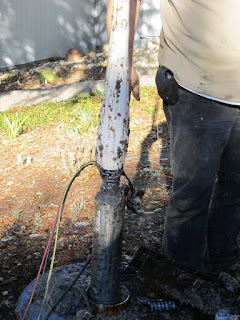
Here's a picture of the entire well pump sitting on the pad around the well:

The top half is the impeller, the bottom half is the motor. Water enters through the grid in the middle and we can see that isn't too blocked up.
Here's a closer view of the slime from the well and the bottom of the pump. I hope you haven't eaten recently:

Yeah. Sorry about that.
And finally, here's the pipe from the well laid out ready to go back in once the problem is fully diagnosed:

The bulge in the last pipe is pretty obvious there. The large, black, football shaped thing two pipes over from the left is a torque arrestor, to keep the pipes from twisting and banging around when the motor kicks in. It fits just inside the six inch plastic pipe that lines the well.
My well guy took the pump and controller off with him today. He will clean up the pump, bench test it all, and find the problem. If the controller is bad he will replace it. In addition - since this is the second time we've seen that pipe bulge up due to a hot pump - he may replace the last 20' section of PVC with stainless steel, to reduce the chances of that happening again. (Of course, if it does happen the stainless will conduct heat better, and it might just move the problem, or it might cause the pump to burn out once it has run too long.)
Hopefully tomorrow he will be able to tell me exactly what failed, and we can start looking to avoid the root cause of the problem. That may mean trying to find some way to protect our entire home from brownouts. We already have a whole house surge protector installed, but nothing keeps a brownout from crippling us.
More when we know it. Whee.
I called our preferred well guy and had him do some diagnosis. I had already verified that we had power getting to the top of the well and that the pump should have been running, but no water was coming out. He was able to duplicate my results and noted that the current flowing in the wires meant the pump was probably running. He bypassed the pump controller and the problem continued, so whatever the issue was it was in the well pump, 380 feet below ground. Oh joy.
Today he came back with his truck to pull the pump and find out what was going on. These pictures document that little voyage of discovery.
First, here's what the well head looked like before things got started:

The line on the right (with the gray box) is the electrical supply that drives the pump. The line in the middle going into the ground is the water discharge. That goes off to our storage tanks. The strange looking plastic pipe on the left is a home made sulfur discharge vent, since the old metal one corroded and goobered up the threads it was screwed into. The first 50 feet of the well is surrounded by concrete to keep ground water from contaminating the well. Most of that 50 feet has only a couple of inches around it, but the cap has a much wider pad to protect the well head from lawn mowers and the like.
And here we see what it looks like with the well seal opened up and the first couple of feet of pipe extracted:

The electrical was disconnected, the sulfur vent removed, and the union in the water line opened up. At this point all 380 feet of pipe are hanging from a cable on a truck designed for this purpose. It looks like this:

That picture was taken a bit later. You can see a 20' length of schedule 80 PVC pipe hanging from the rig. The pipes are threaded and attached with brass couplings. An odd looking device is used to clamp the pipe in place while the section above is disconnected and set aside. Here's a closer view of that:

The metal thing sitting crosswise at the bottom is the above mentioned clamp. The technician is using the lift to pull the pipe up. His assistant is pulling the electrical wires and a safety rope off to the side to keep them out of the way. (Note that those wires and rope are taped to the pipe at regular intervals, so the tape has to be cut and removed as each pipe is pulled up too.) Also as the pipe comes up the technician wipes the accumulated slime off of it. And in our case there is a lot of that slime. Some combination of iron and sulfur bacteria make for a nasty thick layer of gunk all over everything. (And there will be a better picture of that later.)
As the end of the 19th section of pipe comes out of the ground, we see the well pump emerge, and just before that, a surprise:

OK... this may not look like much to the uninitiated but that's bad. Most of the PVC pipe above the pump is 1" diameter. The last two sections are 1.25" for some technical reason, but they do NOT bow out like that. That's bad. That's very bad.
What it means is that sometime a month or more ago the pump ran, pumped all the water out of the well, but then did not turn off. As it kept running it got hot, since water is the usual coolant for the motor. As the pump got hot it heated the pipe above the pump got too, and the plastic softened. Eventually it got so hot - despite there being water inside the pipe - that a hole opened up in the pipe and the water drained out.
So that bowed out area just above the pump is a bad thing. It means that something is wrong with the pump, the pump controller, or both. Now, as it happens, we had a long brownout or two just over a month ago during a big wind storm. For one of them I was home and awake and ran around turning off breakers, though I honestly don't remember if I got the breaker for the well pump or not. I should have, but who knows. The other brownout, if it affected us, hit while I was asleep, or so I gather from a neighbor. The first was something like 20 minutes long and I have no idea about the other, but either might have caused a fault that could result in this sort of behavior.
Or there might be other causes. Time will tell.
Here's a picture of the entire well pump sitting on the pad around the well:

The top half is the impeller, the bottom half is the motor. Water enters through the grid in the middle and we can see that isn't too blocked up.
Here's a closer view of the slime from the well and the bottom of the pump. I hope you haven't eaten recently:

Yeah. Sorry about that.
And finally, here's the pipe from the well laid out ready to go back in once the problem is fully diagnosed:

The bulge in the last pipe is pretty obvious there. The large, black, football shaped thing two pipes over from the left is a torque arrestor, to keep the pipes from twisting and banging around when the motor kicks in. It fits just inside the six inch plastic pipe that lines the well.
My well guy took the pump and controller off with him today. He will clean up the pump, bench test it all, and find the problem. If the controller is bad he will replace it. In addition - since this is the second time we've seen that pipe bulge up due to a hot pump - he may replace the last 20' section of PVC with stainless steel, to reduce the chances of that happening again. (Of course, if it does happen the stainless will conduct heat better, and it might just move the problem, or it might cause the pump to burn out once it has run too long.)
Hopefully tomorrow he will be able to tell me exactly what failed, and we can start looking to avoid the root cause of the problem. That may mean trying to find some way to protect our entire home from brownouts. We already have a whole house surge protector installed, but nothing keeps a brownout from crippling us.
More when we know it. Whee.
Subscribe to:
Posts (Atom)